Linear Algebra
Vector Space
Definition
Motivation: properties of addition and scalar multiplication in $ \mathbf{F}^n $
flowchart LR
subgraph addGroup["$$u + v$$"]
direction TB
addSet["abelian group under addition"]
end
subgraph scalarGroup["$$\lambda v$$"]
direction TB
scalarSet["• associativity<br/>• 1"]
end
addSet <-->|distributive<br/>properties| scalarSet
style addGroup fill:transparent,stroke:transparent
style scalarGroup fill:transparent,stroke:transparent
Examples
- $ \mathbf{F}^S $
- $ \mathcal{P}(\mathbf{F}) $
- $ \mathcal{P}_m(\mathbf{F}) $
| $ \dim $ | |
|---|---|
| $ \mathcal{L}(V, W) $ | $ (\dim V)(\dim W) $ |
| $ \mathbf{F}^{m,n} $ | $ mn $ |
| $ V_1 \times \dots \times V_m $ | $ \dim V_1 + \dots + \dim V_m $ |
| $ V’ $ | $ \dim V $ |
| $ \mathcal{B}(V, W) $ | $ (\dim V)(\dim W) $ |
Subspace
Examples
- $ V_1 \cap \dots \cap V_m $
- $ V_1 \cup V_2 $ ($ \Leftrightarrow V_1 \subseteq V_2 $ or $ V_1 \supseteq V_2 $)
- $ V_1 + \dots + V_m $ (Smallest containing subspace)
Suppose $V$ is finite-dimensional and $ U $ is a subspace of $ V $:
| $ \dim $ | |
|---|---|
| $ U $ | $ \leq \dim V $ ($ = \dim V \iff U = V $) |
| $ V/U $ | $ \dim V - \dim U $ |
| $ U^0 $ | $ \dim V - \dim U $ |
| $ U^{\perp} $ | $ \dim V - \dim U $ |
| $ E(\lambda, T) $ | algebraic multiplicity |
| $ G(\lambda, T) $ | geometric multiplicity |
Sum
Analogy between sets and vector spaces:
- Cardinality: Dimension
- Union: Sum
- Union of disjoint sets: Direct sum
Number of Vectors
The number of vectors equals the number of choices of the coefficient tuple $(a_1, \dots, a_n)$:
\[\#(\text{vectors}) = \lvert \mathbf{F} \rvert ^n\]Finite fields exist precisely for prime-power sizes $q = p^k$.
| over $\mathbb{R}$ or $\mathbb{C}$ | over $\mathbf{F}_q$ | |
|---|---|---|
| trivial space | $1$ | $1$ |
| dimension $n \geq 1$ | $\infty$ | $q^n$ |
| #{ordered bases} | $\infty$ | \(\lvert GL_n(\mathbf{F}_q) \rvert = \prod_{k=0}^{n-1}(q^n - q^k)\) |
Bases
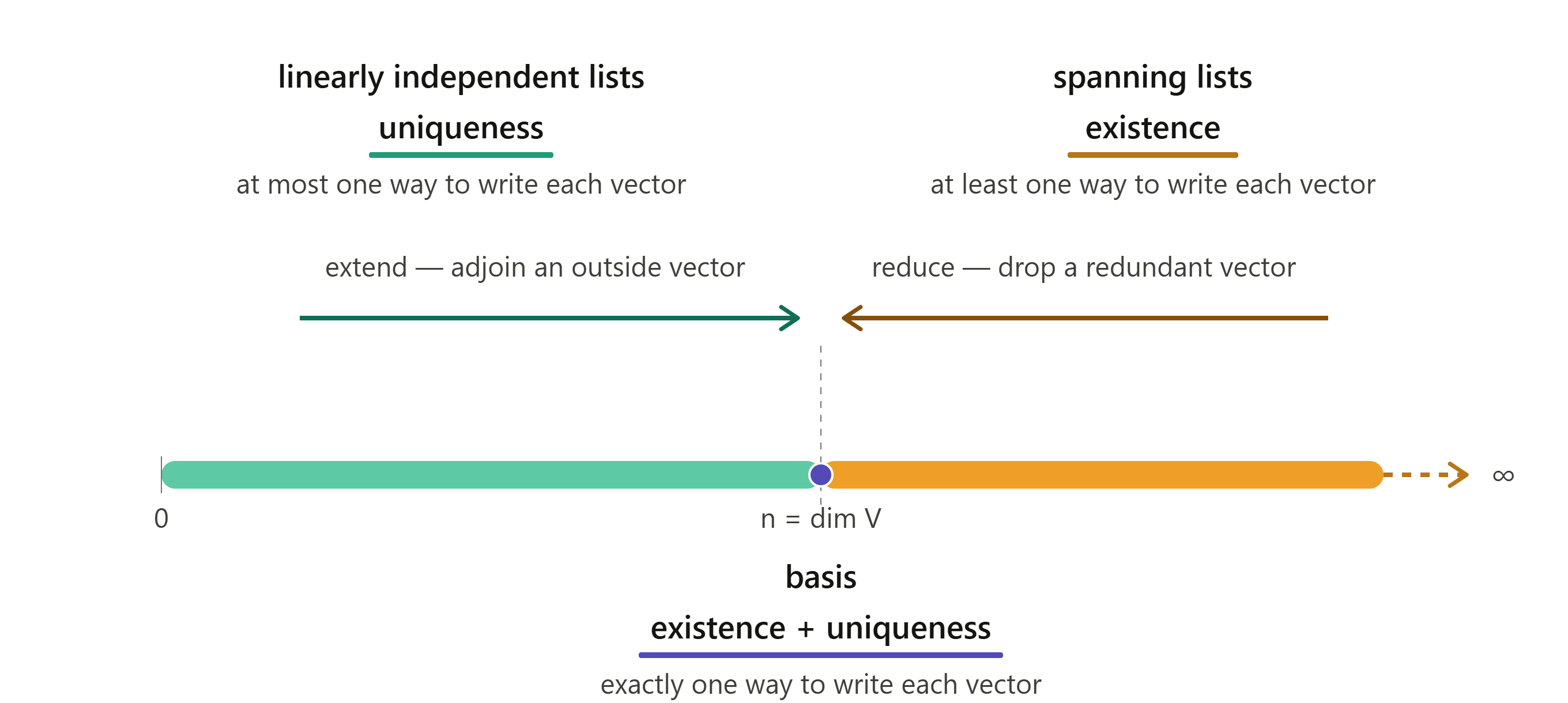
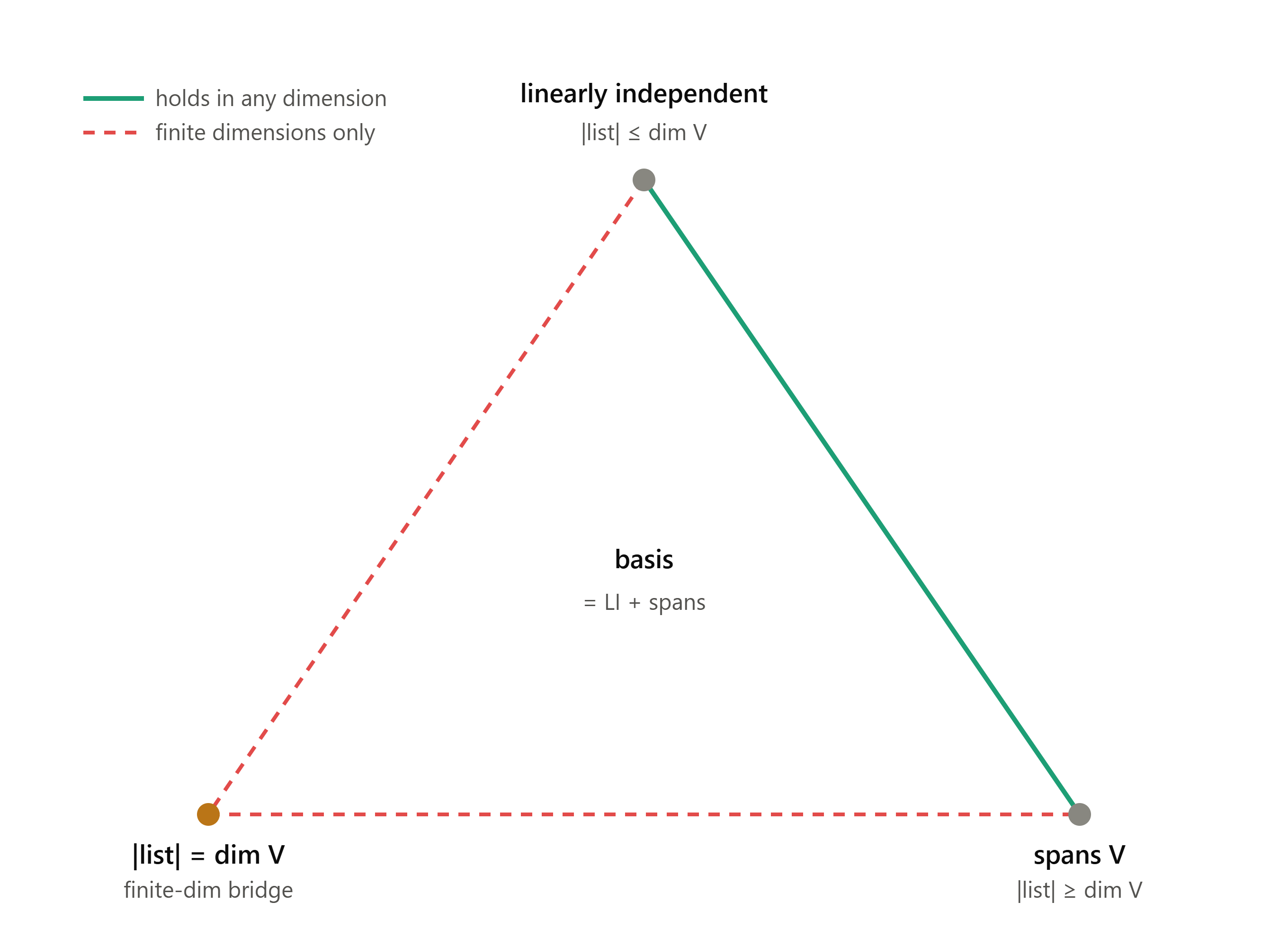
Suppose we allow infinite families, read “spans/independent” in the finite-linear-combination sense, and read “length $= \dim V$” as “cardinality equals $\dim V$” (a Hamel basis).
(a) Take $V = \mathcal P(\mathbb F)$, polynomials, with basis $1, x, x^2, \dots$ so $\dim V = \aleph_0$. Then ${x, x^2, x^3, \dots}$ (drop the constant) is linearly independent with cardinality $\aleph_0 = \dim V$, yet it can’t produce the constant $1$, so it doesn’t span — independent, right size, not a basis.
(b) ${1, x, x^2, \dots} \cup {1+x}$ spans and still has cardinality $\aleph_0$, but it’s dependent — spanning, right size, not a basis.
A direct-sum decomposition of $ V $ is the same thing as a partition of a basis of $ V $.
$ \dim (V_1 + \dots + V_m) \le \dim V_1 + \dots + \dim V_m $
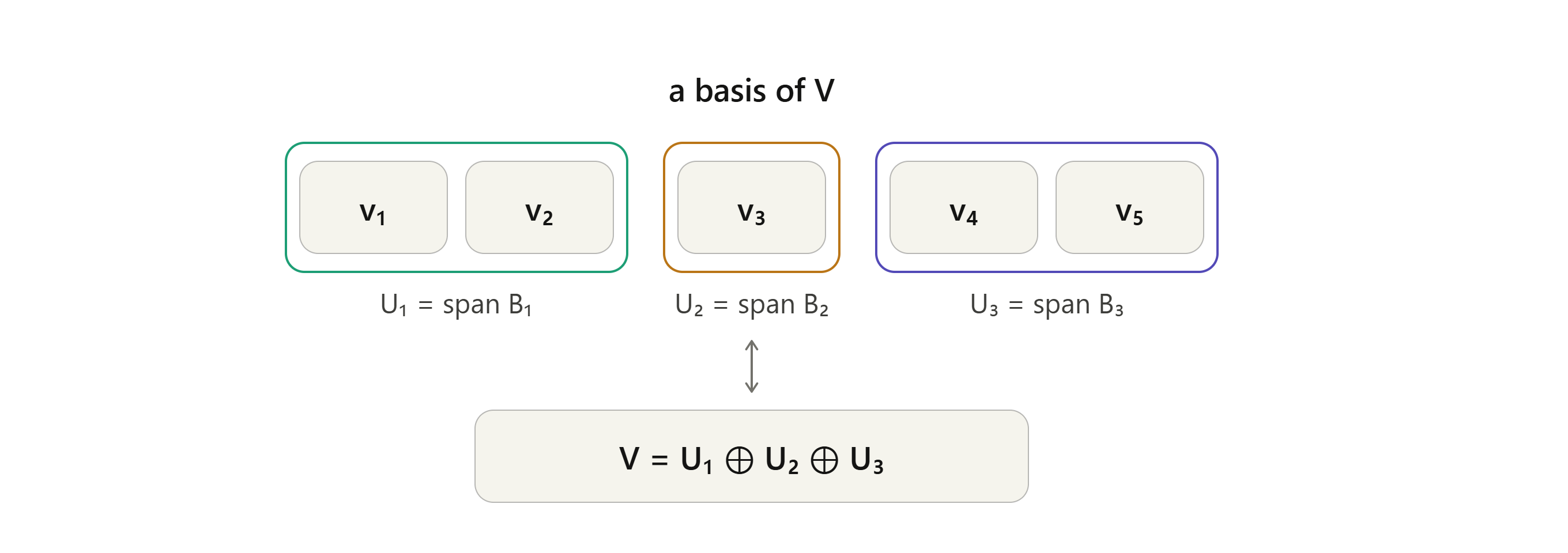
A sum is a direct sum iff dimensions add up.
Direct Sum Decomposition
- Suppose $T \in \mathcal{L}(V)$. $V = \dim \operatorname{null} T^m = \dim \operatorname{null} T^{m + 1} $.
- Suppose $\mathbf{F} = \mathbb{C}$ and $T \in \mathcal{L}(V)$. $ V = \oplus G(\lambda, T)$.
- Suppose $V$ is finite-dimensional, $T \in \mathcal{L}(V)$ and $T$ is diagonalizable. $ V = \oplus E(\lambda, T)$.
Suppose $\mathbf{F} = \mathbb{C}$ and $T \in \mathcal{L}(V)$. Then
There does not exist a direct sum decomposition of $V$ into two nonzero subspaces invariant under $T$ $iff$ the minimal polynomial of $T$ is of the form $(z - \lambda)^{\dim V}$ for some $\lambda \in \mathbb{C}$.
If $v_1,\dots,v_n$ is a basis, then replacing $v_i$ by $v_i + c\,v_j$ for any $j \neq i$ and any scalar $c$ again gives a basis. (
It’s an elementary column operation; invertibility is obvious because you can undo it.
Linear Maps
Examples
- $ T : V \to W $
- $ \Gamma : V_1 \times \dots \times V_m \to V_1 + \dots + V_m $ (Invertible iff $ V_1, \dots, V_m $ is a direct sum)
- Quotient map: $ \pi : V \to V/U $, $ \pi(v) = v + U $
- $ \tilde{T} ∶ V/(\operatorname{null} T) \to W $, $ \tilde{T}(v + \operatorname{null} T) = Tv $
- $ \tilde{T} \circ \pi = T $
- $ T \to T’ $
- $ P_U \in \mathcal{L}(V) $
- $ (\operatorname{null} T)^{\perp} \to \operatorname{range} T $ (Invertable)
- $ T^{\ast} $
A linear map may be prescribed freely on a basis:
Suppose $ v_1, \dots, v_n \in V $ is a basis of $ V $ and $ w_1, \dots, w_n \in W $, $ \exists! T \in \mathcal{L}(V, W) \ \text{s.t.} $
\[Tv_k = w_k\]for each $k = 1, \dots, n$
$ T(c_1v_1 + \dots + c_nv_n) = c_1w_1 + \dots + c_nw_n $
Extension
$ V $ is finite-dimensional:
$ U $ is a subspace of $ V $, $ S \in \mathcal{L}(U, W) \Rightarrow \exists T \in \mathcal{L}(V, W) \ \text{s.t.} \ T \vert _U = S $
Extend a basis $ u_1,\dots,u_m$ of $U $ to a basis $ u_1,\dots,u_m,\,v_1,\dots,v_n $ of $ V $. Define $ T u_i = S u_i $ and $ T v_j = $ anything in $ W $; extend linearly.
Algebraic Operations
- $ \mathcal{L}(V, W) $ is a vector space
- Product of linear maps is a bilinear map
Null Spaces and Ranges

Fundamental theorem of linear maps
Suppose $V$ is finite-dimensional. $ T \in \mathcal{L}(V, W) $:
\[\dim V = \dim \operatorname{null} T + \dim \operatorname{range} T\]
Generalization
Suppose $V$ is finite-dimensional. $ T \in \mathcal{L}(V, W) $, $ U $ is a subspace of $ W $:
\[\dim \{ v \in V : Tv \in U \} = \dim \operatorname{null} T + \dim (U \cap \operatorname{range} T)\]
Cokernel
Suppose $ T \in \mathcal{L}(V,W) $,
\[\operatorname{coker}T = W/\operatorname{range}T.\]
Cokernel is the dual of the null space: $\operatorname{null}T$ measures failure of injectivity, $\operatorname{coker}T$ measures failure of surjectivity, and $T$ is onto iff $\operatorname{coker}T = 0$.
Injectivity, Surjectivity and Invertibility
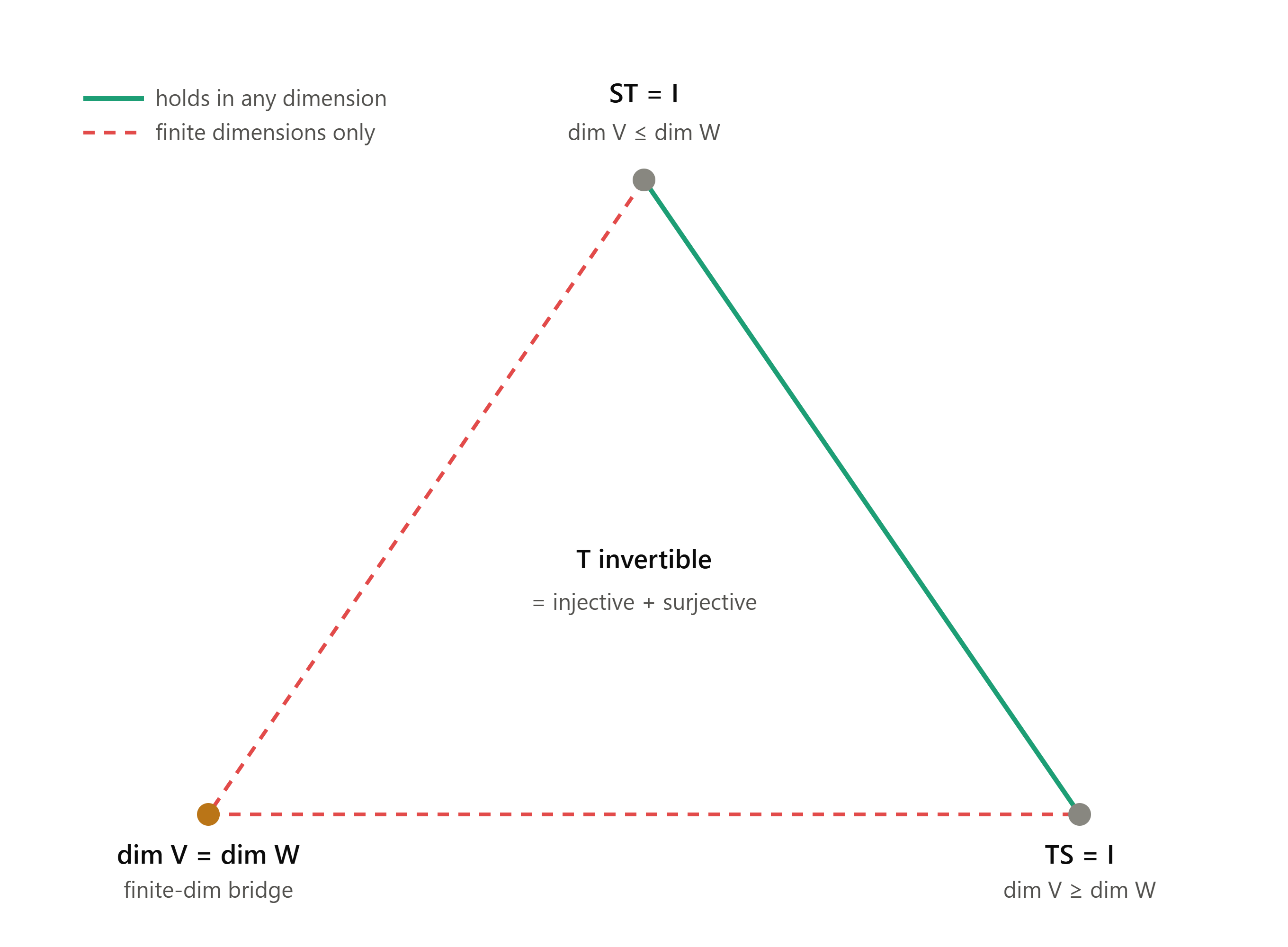 Inveritibility Triangle
In infinite dimensions $ST = I$ does not imply $TS = I$. The standard counterexample is the shift operators on infinite sequences: left‑shift $L$ and right‑shift $R$ satisfy $LR = I$ but $RL \ne I$, and neither is invertible.
Suppose $ T \in \mathcal{L}(V, W) $.
(a) If $ T $ is injective, the co-restriction $ \tilde T : V \to \operatorname{range} T $, $ v \mapsto Tv $, is a bijection.
(b) Decompose $ V = \operatorname{null} T \oplus U $, then $T\rvert_U : U \to \operatorname{range} T$ is an isomorphism.
$ \iff $
| $ T \in \mathcal{L}(V, W) $ | Injective | Surjective | Invertible (Isomorphic) |
|---|---|---|---|
| Definition | $ \operatorname{null} T = \{ 0 \} $ | $ \operatorname{range} T = W $ | $ T $ is injective and $ T $ is surjective |
| Preservation | linear independence | spanning | basis |
| Inverse | $ T $ has a left inverse: $ ST = I $ | $ T $ has a right inverse: $ TS = I $ | $ T $ has the inverse: $ ST = I $ and $ TS = I $ |
| Complexification | $ T_{\mathbb{C}} $ is injective | $ T_{\mathbb{C}} $ is surjective | $ T_{\mathbb{C}} $ is invertible |
| Dual map | $ T’ $ is surjective | $ T’ $ is injective | $ T’ $ is invertible |
| $ \mathcal{M}(T) \in \mathbf{F}^{m,n} $ | columns linearly independent; rows span $ \mathbf{F}^{1,n} $; $ \operatorname{rank} = n $ | rows linearly independent; columns span $ \mathbf{F}^{m,1} $; $ \operatorname{rank} = m $ | columns are a basis; rows are a basis; $ \operatorname{rank} = m = n $ |
| $ T^m $ | $ T^m $ is injective | $ T^m $ is surjective | $ T^m $ is invertible |
| Singular value | $ 0 $ is not a singular value of $ T $ | #(positive singular values of $ T $) = $ \dim W $ |
$ \implies $
| $ T \in \mathcal{L}(V, W) $ | Injective | Surjective | Invertible (Isomorphic) |
|---|---|---|---|
| Dimensions (Finite) | $ \dim V \leq \dim W $ | $ \dim V \geq \dim W $ | $ \dim V = \dim W $ |
| $\dim V = \dim W$ | (all three coincide) | (all three coincide) | (all three coincide) |
| Pseudoinverse | $ TT^{\dagger} = I $ | $ T^{\dagger}T = I $ | $ TT^{\dagger} = T^{\dagger}T = I $ |
$ \iff $
| $ T \in \mathcal{L}(V) $ | Invertible |
|---|---|
| Minimal polynomial | Constant term is not $0$ |
$ \lambda $ is an eigenvalue of $ T \iff T - \lambda I $ is not invertible
Product
Suppose $U$ and $V$ are finite-dimensional. $ S \in \mathcal{L}(V, W) $ and $ T \in \mathcal{L}(U, V) $:
- $ \operatorname{null} T \subseteq \operatorname{null} ST $
- $ \operatorname{range} ST \subseteq \operatorname{range} S $
Suppose $ U $ and $ V $ are finite-dimensional. $ S \in \mathcal{L}(V, W) $ and $ T \in \mathcal{L}(U, V) $:
- $ \dim \operatorname{null} ST \leq \dim \operatorname{null} S + \dim \operatorname{null} T $
- $ \dim \operatorname{range} ST \leq \min(\dim \operatorname{range} S + \dim \operatorname{range} T) $
Suppose $ V $ is finite-dimensional and $ S, T \in \mathcal{L}(V, W) $, then
$ ST $ is invertible $\iff$ $ S $ and $ T $ are invertible.
Isomorphism
- $ V/\operatorname{null} T \cong_\tilde{T} \operatorname{range} T, \quad \tilde{T} ∶ V/(\operatorname{null} T) \to W $, $ \tilde{T}(v + \operatorname{null} T) = Tv $
- $ \mathcal{L}(V, W) \cong \mathbf{F}^{m,n} $
- $ V \cong \mathcal{L}(\mathbf{F}, V) $
- $ V^m \cong \mathcal{L}(\mathbf{F}^m, V) $
- $ V \cong U \times V/U $
Matrices
$ \mathcal{M}(T,(v_1,\dots,v_n),(w_1,\dots,w_m)) \in \mathbf{F}^{m,n} $ is the matrix representation of $ T $ with respect to the chosen bases.
\[Tv_k = \sum_{j=1}^m {A_{j,k}w_j}\]$ T \in \mathcal{L}(\mathbf{F}^n, \mathbf{F}^m) $, $ \mathcal{M}(T,(e_1, \dots, e_n), (e_1, \dots, e_m))_{\cdot,k} = Te_k $
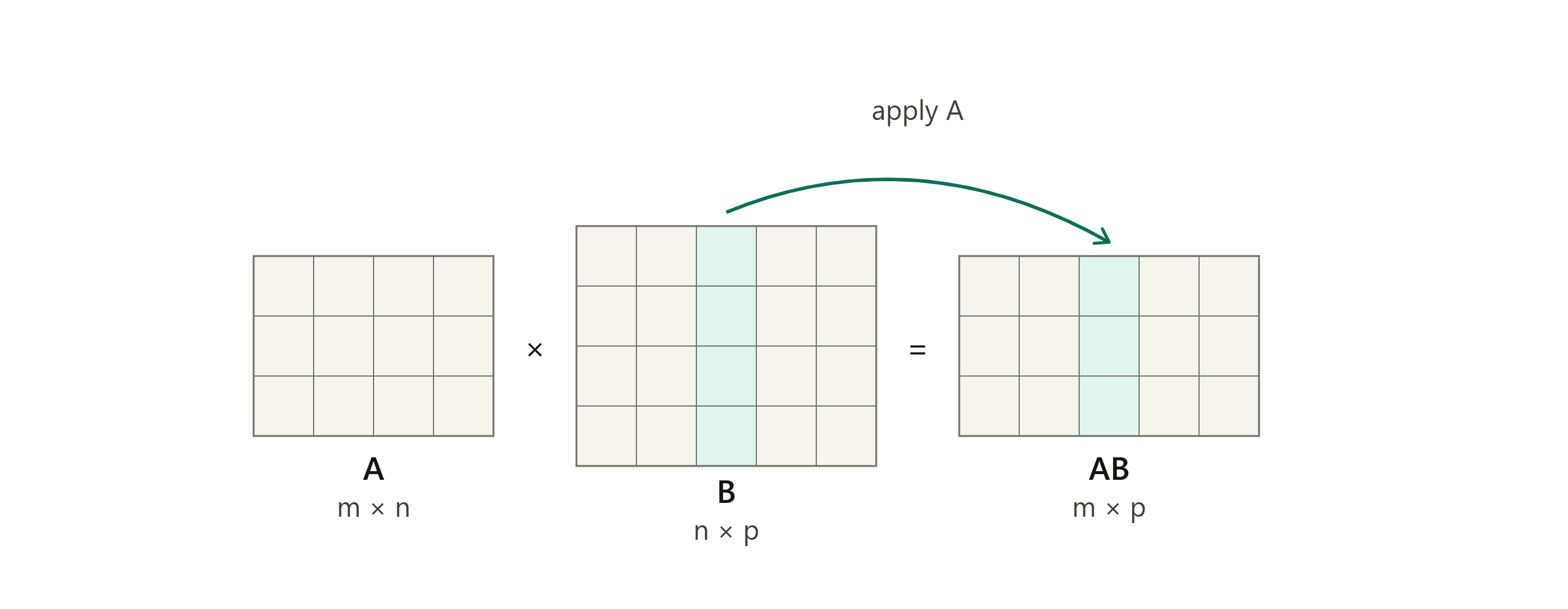
Column of matrix product equals matrix times column
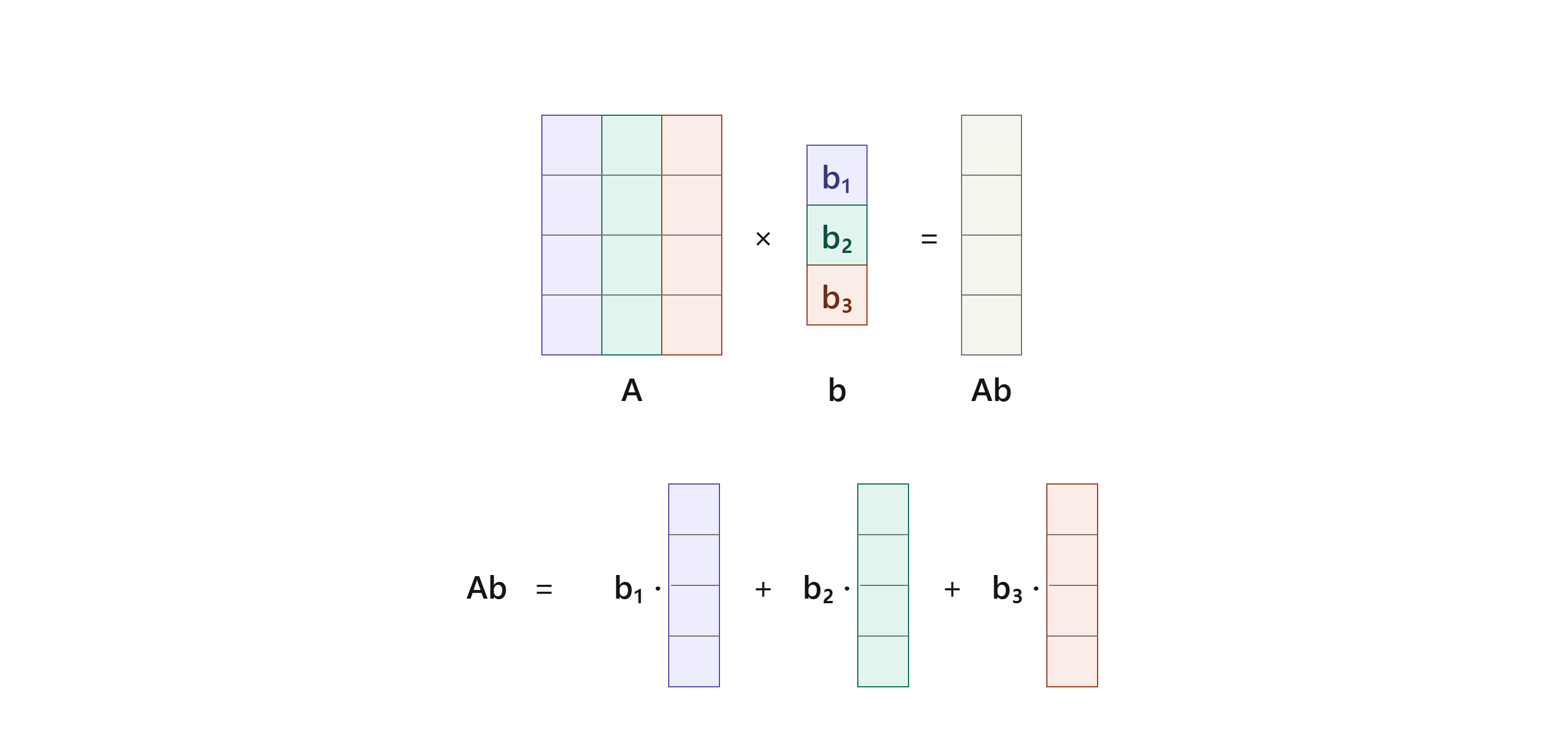
Linear combination of columns
$ \dim \operatorname{range} T = \operatorname{rank} \mathcal{M}(T) $
Column–row factorization
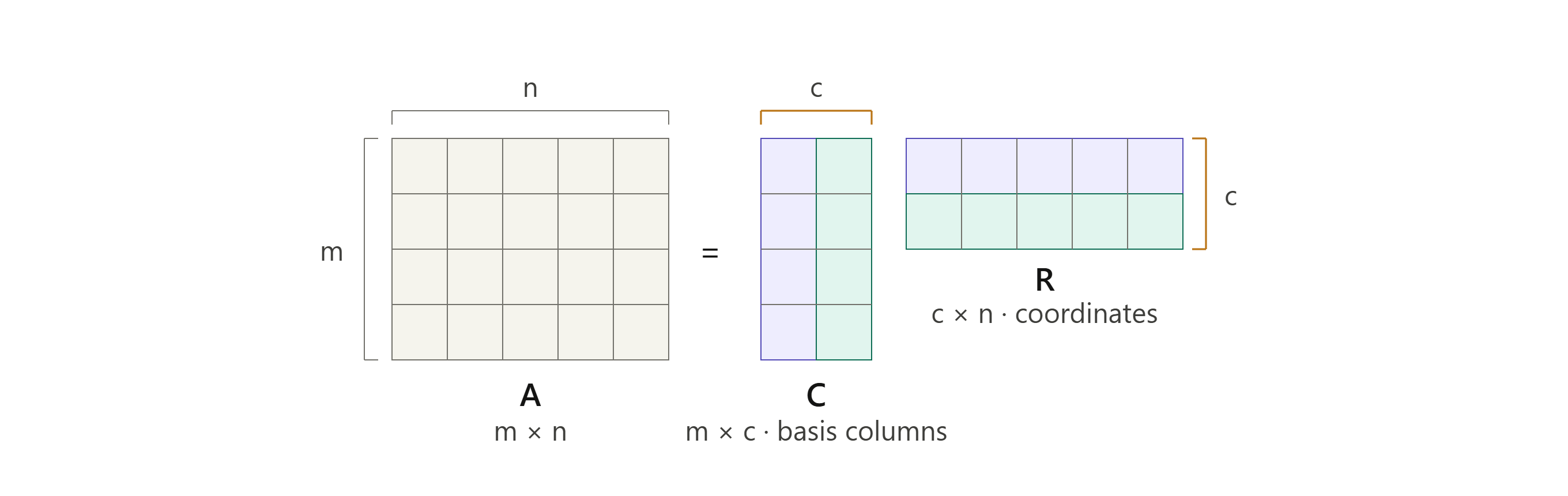
$ C $ is a basis of the column space.
$ A \mapsto A^T $ is a linear map
Change-of-basis
\[\mathcal{M}(I,(u_1,\dots,u_n),(v_1,\dots,v_n))\mathcal{M}(I,(v_1,\dots,v_n),(u_1,\dots,u_n)) = I\]$ T \in \mathcal{L}(V) $, $ A = \mathcal{M}(T,(u_1,\dots,u_n)), B = \mathcal{M}(T,(v_1,\dots,v_n)), C = \mathcal{M}(I,(u_1,\dots,u_n),(v_1,\dots,v_n))$:
\[A = C^{-1}BC\]
Similarity
$ A, B \in \mathbf{F}^{n,n} $ are similar if $ A = C^{-1}BC $ for some invertible $ C \in \mathbf{F}^{n,n} $. Likewise $ S, T \in \mathcal{L}(V) $ are similar if $ S = C^{-1}TC $ for some invertible $ C \in \mathcal{L}(V) $.
Change-of-basis is exactly what makes the two readings agree: $ S $ and $ T $ are similar $ \iff $ they have the same matrix with respect to some pair of bases,
\[\mathcal{M}(S,(u_1,\dots,u_n)) = \mathcal{M}(T,(v_1,\dots,v_n)).\]($ \Rightarrow $) take $ (v_1,\dots,v_n) $ and set $ u_i = C^{-1}v_i $. ($ \Leftarrow $) let $ C $ be the invertible operator with $ Cu_i = v_i $.
| $ T \in \mathcal{L}(V, W) $ | Inverse | Dual Map | Adjoint |
|---|---|---|---|
| Existence | Inveritibility Triangle | ||
| Uniqueness | $ T^{-1} \in \mathcal{L}(W, V) $ | ||
| Matrix | $ \mathcal{M}(T^{-1}) = (\mathcal{M}(T))^{-1} $ | $ \mathcal{M}(T’) = (\mathcal{M}(T))^t $ | $ \mathcal{M}(T^{*}) = (\mathcal{M}(T))^{*} $ |
| Involution | $ (T^{-1})^{-1} = T $ | $ (T^{*})^{*} = T $ | |
| Anti-homomorphism | $ (ST)^{-1} = T^{-1}S^{-1} $ | $ (ST)’ = T’S’ $ | $ (ST)^{*} = T^{*}S^{*} $ |
| $ \mathbb{C} $ | $ \mathbb{R} $ | |
|---|---|---|
| Polynomial factorization (unique) | $ p(z) = c(z - \lambda_1)\dots(z - \lambda_m) $ | $ p(x) = c(x - \lambda_1)\dots(x - \lambda_m)(x^2 + b_1x + c_1)\dots(x^2 + b_Mx + c_M) $ |
| #{zeros of a polynomial} (counted with multiplicity) | $ m = \deg p $ | $ \le \deg p $ |
| Existence of eigenvalues ($ \forall T $) | Nonzero complex vector space | Odd-dimension real vector space |
| $ T \in \mathcal{L}(V, W) $ | null space | range | $ \dim \operatorname{null} $ | $ \dim \operatorname{range} $ | norm |
|---|---|---|---|---|---|
| $ T’ $ | $ (\operatorname{range} T)^0 $ | $ (\operatorname{null} T)^0 $ | $ \dim \operatorname{null} T + \dim W - \dim V $ | $ \dim \operatorname{range} T $ | |
| $ T^{*} $ | $ (\operatorname{range} T)^{\perp} $ | $ (\operatorname{null} T)^{\perp} $ | $ \left\lVert T \right\rVert $ | ||
| $ T^{*}T $ | $ \operatorname{null} T $ | $ \operatorname{range} T^{*} $ | $ \dim T = \dim T^{*} $ |