Eigenvalues and Eigenvectors
Notes on eigenvalues, eigenspaces, generalized eigenspaces, and the ladder of normal forms that sits on top of them: upper-triangular $\to$ primary decomposition $\to$ Jordan $\to$ diagonal.
Notation and Standing Assumptions
Unless stated otherwise: $\mathbf{F}$ is $\mathbb{R}$ or $\mathbb{C}$, $V$ is a nonzero finite-dimensional vector space over $\mathbf{F}$ with $n = \dim V$, and $T \in \mathcal{L}(V)$. Results that genuinely need $\mathbf{F} = \mathbb{C}$ say so explicitly.
| Symbol | Meaning |
|---|---|
| $\mathcal{L}(V)$ | linear operators $V \to V$ |
| $\mathcal{P}(\mathbf{F})$ | polynomials with coefficients in $\mathbf{F}$ |
| $V’$ | dual space of $V$ |
| $T’$ | dual (transpose) operator of $T$ |
| $E(\lambda,T) = \operatorname{null}(T - \lambda I)$ | eigenspace; $\lambda$ is an eigenvalue $\iff E(\lambda,T) \ne {0}$ |
| $G(\lambda,T) = \operatorname{null}(T - \lambda I)^n$ | generalized eigenspace |
| $g_\lambda = \dim E(\lambda,T)$ | geometric multiplicity |
| $d_\lambda = \dim G(\lambda,T)$ | algebraic multiplicity |
| $e_\lambda$ | exponent of $(z-\lambda)$ in the minimal polynomial |
| $J_s(\lambda)$ | Jordan block of size $s$ for $\lambda$ |
| $V_{\mathbb{C}}$ | complexification of a real vector space $V$ |
| $T_{\mathbb{C}}$ | complexification of a real operator $T$ |
Three numbers are attached to each eigenvalue and it pays to keep them apart: $g_\lambda \le e_\lambda \le d_\lambda$, with $g_\lambda = d_\lambda$ exactly when $\lambda$ is not defective.
Invariant Subspaces
Suppose $ U $ is a subspace of $ V $ invariant under $ T $. Then $ U $ is invariant under $ p(T) $ for every polynomial $ p \in \mathcal{P}(\mathbf{F}) $.
Every subspace of an eigenspace is invariant.
An arbitrary intersection of $T$-invariant subspaces is $T$-invariant.
Every Line Invariant
The $k = 1$ case is the base of everything below: a $1$-dimensional invariant subspace is exactly the span of an eigenvector.
Suppose every nonzero vector in $ V $ is an eigenvector of $ T $. Then $ T $ is a scalar multiple of the identity operator.
Write $\lambda_u$ for the eigenvalue attached to a nonzero $u$, so $Tu = \lambda_u u$. Fix nonzero $u, w \in V$.
If $w = cu$ for some $c \ne 0$, then $\lambda_w w = Tw = c\,Tu = c\lambda_u u = \lambda_u w$, so $\lambda_w = \lambda_u$.
If $u, w$ are independent, then $u + w \ne 0$ and
\[\lambda_{u+w} u + \lambda_{u+w} w = T(u+w) = \lambda_u u + \lambda_w w.\]Independence forces $\lambda_u = \lambda_{u+w} = \lambda_w$. So $\lambda_u$ is the same scalar $\lambda$ for every nonzero $u$, i.e. $T = \lambda I$. $\blacksquare$
Every $k$-Dimensional Subspace Invariant
Lemma. Suppose $ k \in \{ 1, \dots, n - 1 \} $ and $ v \in V $ is nonzero. Then
\[\bigcap \{U \subseteq V : \dim U = k,\ v \in U\} = \operatorname{span}(v).\]
The $\supseteq$ direction is trivial ($v$ is in each such $U$). For $\subseteq$, I show any $w \notin \operatorname{span}(v)$ can be excluded by some $k$-subspace through $v$ — so $w$ can’t be in the intersection.
Suppose $w \notin \operatorname{span}(v)$. Then $v, w$ are independent, so extend them to a basis
\[v,\ w,\ x_3,\ \dots,\ x_n.\]Now set
\[U = \operatorname{span}(v,\ x_3,\ x_4,\ \dots,\ x_{k+1}) = \operatorname{span}(v) + \operatorname{span}(x_3,\dots,x_{k+1}).\]That’s $v$ together with $k-1$ of the $x_i$’s (an empty list when $k = 1$), so $\dim U = k$, and $v \in U$; the vectors $x_3,\dots,x_{k+1}$ exist because $k + 1 \le n$. But $w \notin U$: the vectors $v, x_3, \dots, x_{k+1}$ are part of a basis that also includes $w$, so $w$ is independent of them and hence not in their span. This $U$ contains $v$, has dimension $k$, and misses $w$. $\blacksquare$
Theorem. Suppose $ k \in \{ 1, \dots, n - 1 \} $ and every subspace of $ V $ of dimension $ k $ is invariant under $ T $. Then $ T $ is a scalar multiple of the identity operator.
Let $v \in V$ be nonzero. By the lemma, $\operatorname{span}(v)$ is an intersection of $k$-dimensional subspaces, each invariant by hypothesis, so $\operatorname{span}(v)$ is invariant. Hence $Tv \in \operatorname{span}(v)$, i.e. $v$ is an eigenvector. As every nonzero vector is an eigenvector, $T$ is a scalar multiple of $I$. $\blacksquare$
“Every $k$-dimensional subspace is invariant” collapses to “every line is invariant” — i.e. all the way down to $k=1$ — because a line is recoverable as the intersection of the $k$-subspaces sitting above it.
Eigenvalues and Eigenvectors
Every list of eigenvectors of $ T $ corresponding to distinct eigenvalues of $ T $ is linearly independent.
Suppose $ v_1, \dots, v_m \in V $. Then
$ v_1, \dots, v_m $ is linearly independent $ \iff \exists\, T \in \mathcal{L}(V) $ such that $ v_1, \dots, v_m $ are eigenvectors of $ T $ corresponding to distinct eigenvalues.
Suppose $ \lambda $ is an eigenvalue of $ T $ and $ v_1, \dots, v_n $ is any basis of $ V $. Then
\[\left\lvert \lambda \right\rvert \le n \max\{\left\lvert \mathcal{M}(T, (v_1,\dots,v_n))_{j,k} \right\rvert : 1 \le j, k \le n \}.\]
Inverses
Suppose $ T $ is invertible with minimal polynomial $ p_T $ of degree $ m $. Then $ p_T(0) \ne 0 $ and
\[p_{T^{-1}}(z) = \frac{z^m\, p_T(1/z)}{p_T(0)}.\]
$ p_T(0) \ne 0 $ is exactly the statement that $0$ is not an eigenvalue. The right-hand side is the reversal of $p_T$ (coefficients read backwards), rescaled to stay monic.
Suppose $ T \in \mathcal{L}(V) $ is invertible. For all $\lambda \in \mathbf{F} $ with $\lambda \ne 0$,
(a) $ G(\lambda, T) = G(\frac{1}{\lambda}, T^{-1}) $.
(b) $ E(\lambda, T) = E(\frac{1}{\lambda}, T^{-1}) $.
Duals
Suppose $ \lambda \in \mathbf{F} $. Then
$\lambda$ is an eigenvalue of $T \iff \lambda$ is an eigenvalue of the dual operator $ T’ \in \mathcal{L}(V’). $
Upper Bound on the Number of Distinct Eigenvalues
Tight upper bound on the number of distinct eigenvalues:
\[\#\{\text{distinct eigenvalues of } T\} \;\le\; \min\big(\dim V,\; 1 + \dim \operatorname{range} T\big)\]
Let $\lambda_1, \dots, \lambda_m$ be the distinct nonzero eigenvalues of $T$, with corresponding eigenvectors $v_1, \dots, v_m$.
Each $v_i$ lies in $\operatorname{range} T$, since $\lambda_i \ne 0$ lets us write
\[v_i = T\left(\tfrac{1}{\lambda_i} v_i\right).\]Eigenvectors belonging to distinct eigenvalues are linearly independent, so $\operatorname{range} T$ contains $m$ linearly independent vectors:
\[m \le \dim \operatorname{range} T.\]The eigenvalues of $T$ are these $m$ nonzero ones, plus possibly $0$. Since $0$ is a single value, it adds at most $1$:
\[\#\{\text{distinct eigenvalues}\} \le m + 1 \le 1 + \dim \operatorname{range} T. \qquad \blacksquare\]The bound $\#\{\text{distinct eigenvalues}\} \le \dim V$ is standard, and the minimum of two valid bounds is valid.
Which of the two bounds is better. Let $r = \dim \operatorname{range} T$ and $n = \dim V$, so rank–nullity gives $\dim \operatorname{null} T = n - r$. The comparison turns entirely on whether $0$ is an eigenvalue — equivalently (all the same condition, stated in different vocabulary) whether $\operatorname{null} T \ne \{0\}$, whether $T$ fails to be injective, whether $T$ fails to be invertible, whether $r < n$.
- $0$ is not an eigenvalue ($T$ is invertible). Then $r = n$ and $1 + r = n + 1 > n$, so $\min$ selects $\dim V$. The range bound is valid but vacuous.
- $0$ is an eigenvalue ($T$ is not invertible). Then $r \le n - 1$ and $1 + r \le n$, so $\min$ selects $1 + r$: a strict improvement whenever $r < n - 1$.
This is about $0$ being an eigenvalue, not the only one — it is unrelated to nilpotency. $\operatorname{diag}(0,1,2,3)$ is non-invertible and far from nilpotent.
Nilpotency is in fact where the bound is weakest: for $J_n(0)$ the true count is $1$ while $r = n - 1$ gives a bound of $n$. The only nilpotent operator attaining the bound is $T = 0$, where $r = 0$ and $1 + r = 1$.
Equality.
- $\#\{\text{distinct eigenvalues}\} = 1 + r$ holds iff, in some basis, $T = \operatorname{diag}(0, \dots, 0, \lambda_1, \dots, \lambda_r)$ with the $\lambda_i$ distinct and nonzero — equivalently: $T$ is diagonalizable, $0$ is an eigenvalue, and every nonzero eigenvalue has geometric multiplicity $1$.
- $\#\{\text{distinct eigenvalues}\} = \dim V$ holds iff $T$ has $n$ distinct eigenvalues, i.e. $T = \operatorname{diag}(\lambda_1, \dots, \lambda_n)$ in some basis with the $\lambda_i$ distinct. One of them is allowed to be $0$.
Null Space and Range Chains
Suppose $m$ is a nonnegative integer. Then
\[\operatorname{null} T^m = \operatorname{null} T^{m + 1} \iff \operatorname{range} T^m = \operatorname{range} T^{m + 1}\]and once either holds at $m$, it holds at every $m’ \ge m$.
So the null-space chain and the range chain stabilize at the same index; call it the stabilization index.
The stabilization index equals the nilpotency index of $ \left. T \right\rvert_{G(0,T)} $.
The chains always stabilize by $m = n$, which is why $G(\lambda,T) = \operatorname{null}(T-\lambda I)^n$ is a safe uniform definition — but the true stabilization index is usually much smaller, namely $e_\lambda$.
Suppose $V_1,\dots,V_m$ are nonzero subspaces of $V$ with $V = \bigoplus_{k=1}^m V_k$, each $V_k$ invariant under $T$, and write $n_k = \dim V_k$. Then for every $\lambda \in \mathbf{F}$,
\[\operatorname{null}(T-\lambda I)^j = \bigoplus_{k=1}^m \operatorname{null}\big(\left.T\right\rvert_{V_k}-\lambda I\big)^j \qquad \text{for every } j \ge 0,\]and likewise $\operatorname{range}(T-\lambda I)^j = \bigoplus_k \operatorname{range}(\left.T\right\rvert_{V_k}-\lambda I)^j$.
Taking $j = 1$ gives $E(\lambda, T) = \bigoplus_k E(\lambda, \left.T\right\rvert_{V_k})$; taking any $j \ge \max_k n_k$ (in particular $j = n$) gives $G(\lambda, T) = \bigoplus_k G(\lambda, \left.T\right\rvert_{V_k})$.
Everything in this post is therefore computed blockwise. Immediately: $g_\lambda$ and $d_\lambda$ add across the blocks, the stabilization index of $T - \lambda I$ is $\max_k$ of the blockwise ones (so $e_\lambda = \max_k e_\lambda^{(k)}$, i.e. the minimal polynomial is the lcm of the blocks’), and the characteristic polynomial is their product. This is the engine behind both the primary decomposition and the Jordan form: choose the $V_k$ well and each block becomes trivial to read.
Generalized Eigenspaces
An eigenvalue $\lambda$ of $T$ is called defective when $\dim E(\lambda, T) \;<\; \dim G(\lambda, T)$, i.e. $g_\lambda < d_\lambda$.
$\operatorname{rank}\big(\left.(T - \lambda I)\right\rvert_{G(\lambda,T)}\big) = \dim G(\lambda,T) - \dim E(\lambda,T)$
For a single eigenvalue $\lambda$, let $\mu = (m_1 \ge \dots \ge m_k)$ be the sizes of its Jordan blocks (the nilpotent diagram of $\left.(T-\lambda I)\right\rvert_{G(\lambda,T)}$), drawn as columns of boxes:
| reads off as | on the diagram | |
|---|---|---|
| $d_\lambda$ (char. poly exponent) | $\dim G(\lambda,T) = \sum_i m_i$ | total boxes (area) |
| $e_\lambda$ (min. poly exponent) | $m_1$ | height of the tallest column |
| $g_\lambda$ | $k = \mu’_1$ | size of the bottom level |
$g_\lambda = d_\lambda \iff$ every column has height $1 \iff \lambda$ is not defective. An operator with no defective eigenvalues is diagonalizable.
Suppose the distinct eigenvalues of $T$ are $ \lambda_1, \dots, \lambda_m $.
| $G(\lambda_k,T)$ | $E(\lambda_k,T)$ | |
|---|---|---|
| Definition | $\operatorname{null}(T-\lambda_k I)^{j}$, any $j \ge e_{\lambda_k}$ ($j = n$ always works) | $\operatorname{null}(T-\lambda_k I)$ |
| Containment | $E \subseteq G$ | — |
| Invariant | yes | yes |
| Restriction of $T - \lambda_k I$ | nilpotent, index exactly $e_{\lambda_k}$ | zero |
| Sum is direct | always | always |
| Sum is all of $V$ | iff char. poly splits over $\mathbf{F}$ (automatic over $\mathbb{C}$) | iff $T$ diagonalizable |
| Multiplicity | algebraic $d_k = \dim G$ | geometric $g_k = \dim E$, $1 \le g_k \le d_k$ |
| Min. polynomial | $\prod_k (z-\lambda_k)^{e_{\lambda_k}}$ | $\prod_k(z-\lambda_k)$ iff diagonalizable |
| Char. polynomial | $\prod_k (z-\lambda_k)^{d_k}$ | — (always uses $d_k$) |
In an upper-triangular matrix,
\[\{\text{distinct diagonal entries}\} = \{\text{zeros of min poly}\} = \{\text{eigenvalues}\}.\] \[1 \le e_\lambda \le (\text{times } \lambda \text{ appears on the diagonal}) = \dim G(\lambda, T).\]
Eigenspaces of $p(T)$
Suppose $ \mathbf{F} = \mathbb{C}$, $ p \in \mathcal{P}(\mathbb{C}) $ is a nonconstant polynomial, and $ \alpha \in \mathbb{C} $. Then
(a) $G(\alpha,\, p(T)) \;=\; \bigoplus_{\lambda:\, p(\lambda) = \alpha} G(\lambda,\, T).$
(b) $E(\alpha, p(T)) \;\supseteq\; \bigoplus_{\lambda:\,p(\lambda)=\alpha} E(\lambda, T)$, with equality iff $p’(\lambda) \neq 0$ for every defective $\lambda$ in that fiber.
(a) Each $G(\lambda, T)$ is $T$-invariant, hence $p(T)$-invariant. On $G(\lambda, T)$, write $T = \lambda I + N$ where $N$ is nilpotent. Since $\lambda I$ and $N$ commute, the algebraic Taylor expansion of $p$ around $\lambda$ holds:
\[p(T)\big\rvert_{G(\lambda,T)} \;=\; \sum_{j=0}^{\deg p} \frac{p^{(j)}(\lambda)}{j!}\, N^j \;=\; p(\lambda)\,I \;+\; \underbrace{\Big(p'(\lambda)N + \tfrac{p''(\lambda)}{2}N^2 + \dots\Big)}_{=:\,M}.\]The remainder $M$ is a polynomial in $N$ with zero constant term, so it’s nilpotent. That means $p(T)$ acts on $G(\lambda, T)$ as $p(\lambda)I + (\text{nilpotent})$ — its only eigenvalue there is $p(\lambda)$, and the whole block sits inside $G(p(\lambda), p(T))$. Summing over all $\lambda$ with $p(\lambda) = \alpha$ and counting dimensions (both sides decompose $V$) upgrades the inclusion to equality.
(b) Now zoom in from $G$ to $E$ inside a single block. The ordinary eigenspace of $p(T)$ for $\alpha = p(\lambda)$, intersected with $G(\lambda, T)$, is $\operatorname{null}(M)$, whereas $E(\lambda, T) = \operatorname{null}(N)$. Factor $M = N \cdot Q$ with
\[Q = p'(\lambda) I + \tfrac{p''(\lambda)}{2}N + \dots.\]Two cases:
- If $p’(\lambda) \neq 0$, then $Q$ is (nonzero scalar) $+$ (nilpotent), hence invertible, so $\operatorname{null}(M) = \operatorname{null}(N)$. The eigenspace matches exactly.
- If $p’(\lambda) = 0$, then $M$ starts at $N^2$ or higher, so $\operatorname{null}(M) \supseteq \operatorname{null}(N^2)$; and $\operatorname{null}(N^2) \supsetneq \operatorname{null}(N)$ exactly when $N$ has a Jordan block of size $\ge 2$.
So the precise condition for strict growth of the ordinary eigenspace is: $\lambda$ is a critical point of $p$ (i.e. $p’(\lambda)=0$) and $\lambda$ is a defective eigenvalue of $T$ (has a nontrivial Jordan block).
Diagonalizability
Suppose $ \mathbf{F} = \mathbb{C} $ and $\lambda_1, \dots, \lambda_m$ are the distinct eigenvalues of $T$. The following are equivalent.
(a) $T$ is diagonalizable.
(b) $V$ has a basis consisting of eigenvectors of $T$.
(c) $V = E(\lambda_1,T) \oplus \dots \oplus E(\lambda_m,T)$.
(d) $\sum_k \dim E(\lambda_k, T) = \dim V$.
(e) The minimal polynomial of $T$ is $(z-\lambda_1)\cdots(z-\lambda_m)$, i.e. it has no repeated roots.
(f) $ V = \operatorname{null}(T - \lambda I) \oplus \operatorname{range}(T - \lambda I) $ for every $ \lambda \in \mathbb{C} $.
Diagonalizable means the eigenspaces are as big as they can be — big enough to fill $V$. Each condition says “fill $V$” in a different dialect: enough eigenvectors for a basis, eigenspaces summing directly to $V$, dimensions adding to $\dim V$, and — the min-poly one — no eigenvalue needing a repeated factor to be annihilated. A repeated factor is exactly the symptom of an eigenspace that came up short: for
\[T = \begin{pmatrix} 5 & 1 \\\\ 0 & 5 \end{pmatrix},\]$(T - 5I)$ kills $(1,0)$ but only maps $(0,1) \mapsto (1,0)$; it takes a second application to finish the job, so $(z-5)^2$ is the minimal polynomial and $\dim E(5,T) = 1 < 2 = \dim G(5,T)$.
Proof of (a) $\iff$ (f). Let $n = \dim V$.
($\Rightarrow$) If $T$ is diagonalizable, a basis of eigenvectors of $T$ is also a basis of eigenvectors of $T - \lambda I$ (with eigenvalues $\lambda_j - \lambda$), so $T - \lambda I$ is diagonalizable, and for a diagonalizable operator $S$ we have $V = \operatorname{null} S \oplus \operatorname{range} S$.
($\Leftarrow$) Assume $V = \operatorname{null}(T-\lambda I) \oplus \operatorname{range}(T-\lambda I)$ for every $\lambda \in \mathbb{C}$. Fix $\lambda$ and write $S = T - \lambda I$.
Step 1: $\operatorname{null} S = \operatorname{null} S^2$. The inclusion $\subseteq$ always holds. Conversely, if $v \in \operatorname{null} S^2$ then $S(Sv) = 0$, so $Sv \in \operatorname{null} S$; also $Sv \in \operatorname{range} S$. Directness of the sum forces $\operatorname{null} S \cap \operatorname{range} S = \{0\}$, so $Sv = 0$.
Step 2: $G(\lambda, T) = E(\lambda, T)$. By the result on stabilization of the null-space chain, Step 1 with $m = 1$ gives $\operatorname{null} S = \operatorname{null} S^j$ for every $j \geq 1$. Taking $j = n$ and using $G(\lambda,T) = \operatorname{null}(T-\lambda I)^{n}$:
\[G(\lambda, T) = \operatorname{null} S^{n} = \operatorname{null} S = E(\lambda, T).\]Step 3: conclude. Let $\lambda_1, \dots, \lambda_m$ be the distinct eigenvalues of $T$ (there is at least one, since $V \neq \{0\}$ and $\mathbf{F} = \mathbb{C}$). The generalized eigenspace decomposition says
\[V = G(\lambda_1, T) \oplus \dots \oplus G(\lambda_m, T).\]By Step 2 each summand equals $E(\lambda_j, T)$, so
\[V = E(\lambda_1, T) \oplus \dots \oplus E(\lambda_m, T),\]which is condition (c). Hence $T$ is diagonalizable. $\blacksquare$
The Hierarchy of Normal Forms
| $T \in \mathcal{L}(V)$ | Basis | Subspaces | Dimensions | Minimal polynomial | Nullspace and range |
|---|---|---|---|---|---|
| Upper-triangularizable | $Tv_k \in \operatorname{span}(v_1,\dots,v_k)$ for each $k$ | $\operatorname{span}(v_1,\dots,v_k)$ invariant for each $k$ | $\lambda_k$ occurs $\dim G(\lambda_k,T)$ times on the diagonal | $(z-\lambda_1)\cdots(z-\lambda_m)$, $\lambda_i \in \mathbf{F}$, repetitions allowed | — |
| Lower-triangularizable | $Tv_k \in \operatorname{span}(v_k,\dots,v_n)$ for each $k$ | $\operatorname{span}(v_k,\dots,v_n)$ invariant for each $k$ | same (reverse the basis) | same | — |
| Primary decomposition | basis is a concatenation of bases of the $G(\lambda_k,T)$; inside group $k$, $(T-\lambda_k I)v \in \operatorname{span}$(earlier vectors of that group) | $V = G(\lambda_1,T)\oplus\dots\oplus G(\lambda_m,T)$, $\lambda_k$ distinct | $\sum_k \dim G(\lambda_k,T) = \dim V$; block $k$ has size $d_k$ | $\prod_k (z-\lambda_k)^{e_{\lambda_k}}$, $\lambda_k$ distinct, $e_{\lambda_k} \ge 1$ | $G(\lambda,T) = \operatorname{null}(T-\lambda I)^{\dim V}$ |
| Jordan form | basis is a disjoint union of chains $v,\,(T{-}\lambda)v,\dots,(T{-}\lambda)^{s-1}v$; equivalently $Tv_k - \lambda v_k \in \{0,\,v_{k-1}\}$ | $V = $ direct sum of indecomposable invariant subspaces, one per chain | number of blocks for $\lambda$: $\dim E(\lambda,T)$; blocks of size $\ge j$: $\dim\operatorname{null}(T{-}\lambda)^j - \dim\operatorname{null}(T{-}\lambda)^{j-1}$ | $\prod_k (z-\lambda_k)^{e_{\lambda_k}}$, exponent $=$ largest block size | $\operatorname{rank}(T-\lambda)^j$ for all $j$ determines the entire diagram |
| Diagonalizable | a basis of eigenvectors of $T$ | $V = E(\lambda_1,T)\oplus\dots\oplus E(\lambda_m,T)$ | $\sum_k \dim E(\lambda_k,T) = \dim V$ | $(z-\lambda_1)\cdots(z-\lambda_m)$, $\lambda_k$ distinct | $V = \operatorname{null}(T{-}\lambda I) \oplus \operatorname{range}(T{-}\lambda I)$ for every $\lambda \in \mathbf{F}$ |
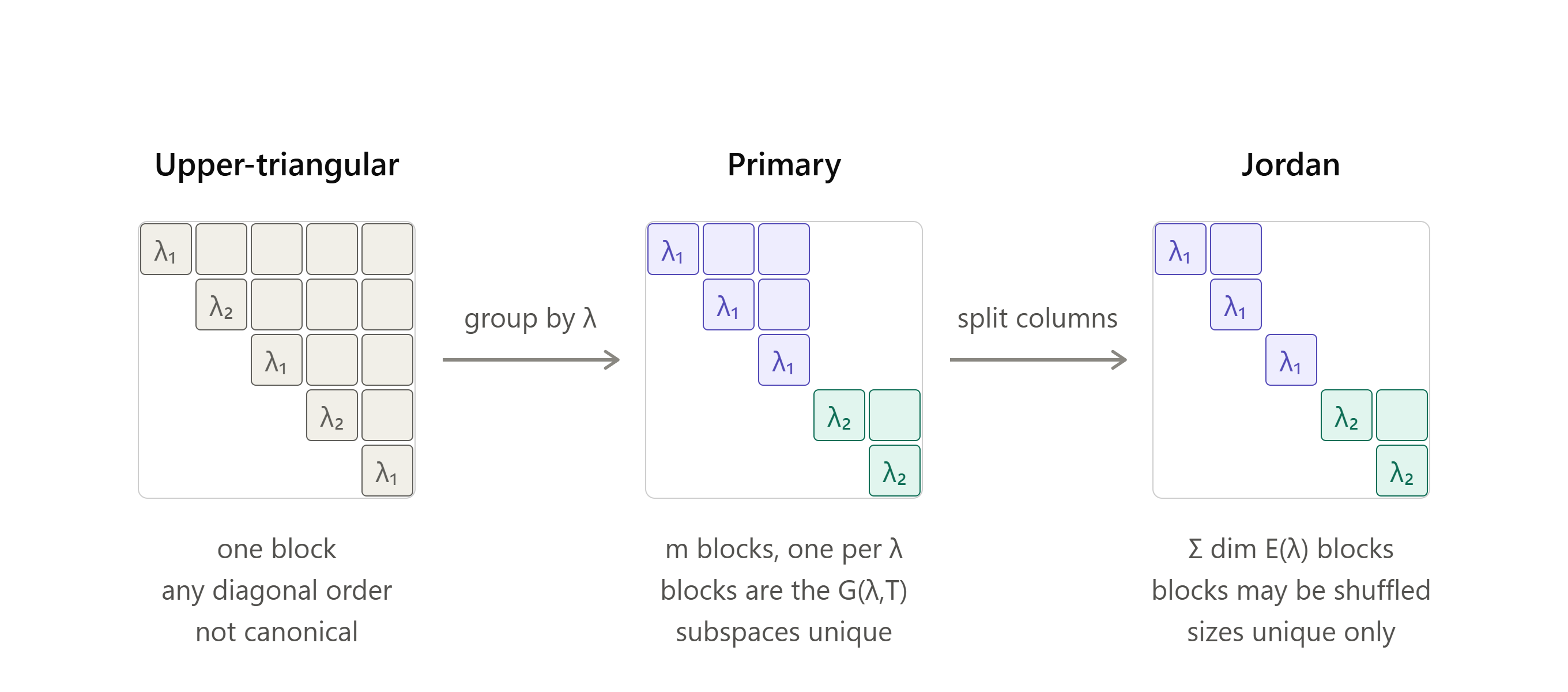 Each step refines the previous one.
Moving right buys you finer blocks and pays for it in uniqueness. The $G(\lambda_k,T)$ are determined by $T$ alone — no choices. The individual Jordan blocks inside a $G$ are not: with $\mu = (2,1)$ there’s a whole family of valid choices for the size-2 and size-1 summands, and only the multiset $\{2,1\}$ is forced.
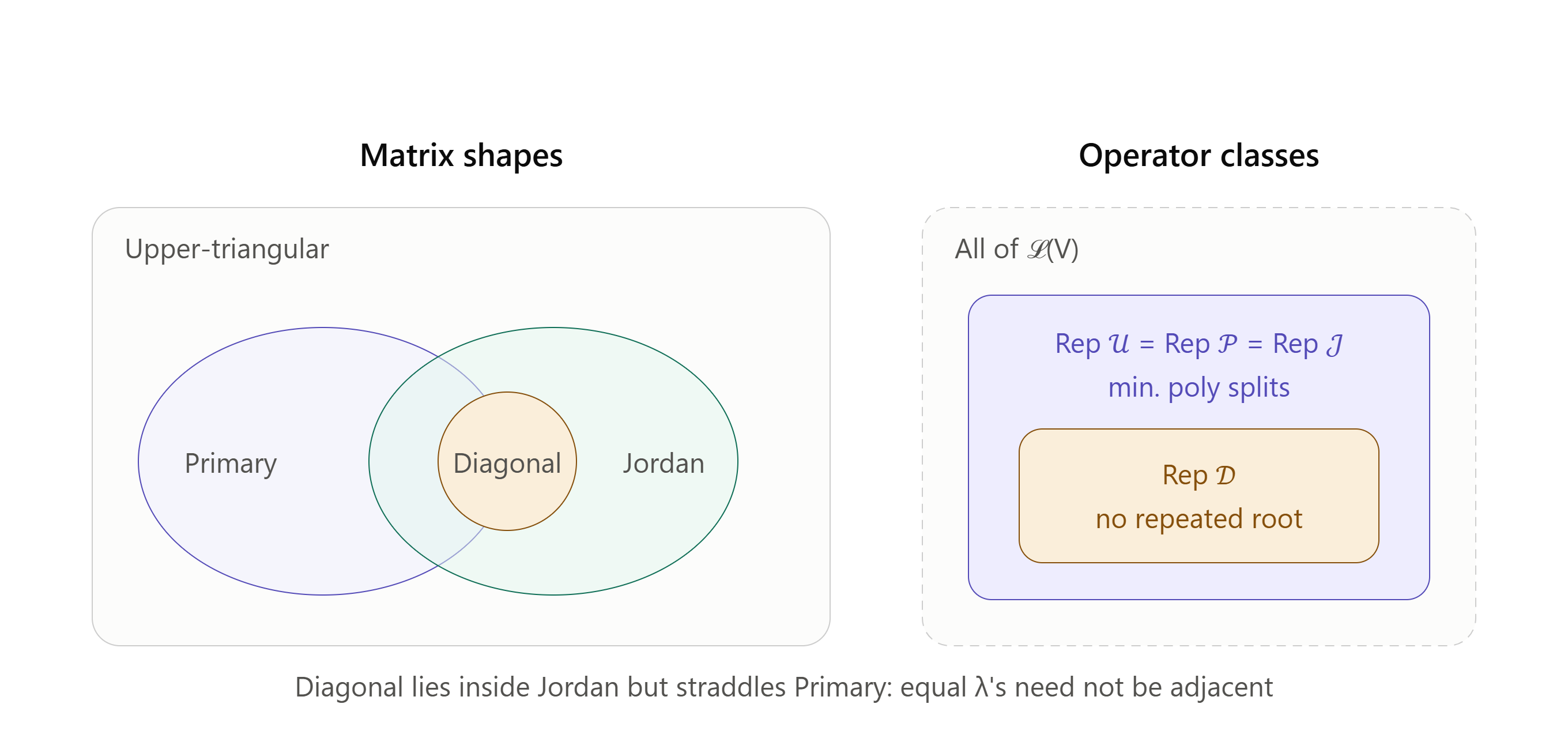 Matrix shapes against the operator classes that realize them.
Density of Diagonalizable Operators
A subset $S \subseteq \mathcal{L}(V)$ is dense if for every $ T \in \mathcal{L}(V) $ and every $ \varepsilon > 0 $ there is $ D \in S $ with $ \lVert T - D \rVert < \varepsilon $.
All norms on the finite-dimensional space $\mathcal{L}(V)$ are equivalent, so density does not depend on which norm is chosen.
Over $\mathbb{C}$, the diagonalizable operators are dense in $\mathcal{L}(V)$.
Let $T \in \mathcal{L}(V)$, $n = \dim V$. Since $\mathbf{F} = \mathbb{C}$, there is a basis $v_1,\dots,v_n$ with respect to which $\mathcal{M}(T)$ is upper triangular, with diagonal entries $\lambda_1,\dots,\lambda_n$. Given $\varepsilon > 0$, choose $\varepsilon_1,\dots,\varepsilon_n \in \mathbb{C}$ with $\lvert \varepsilon_j \rvert < \varepsilon$ such that $\lambda_1 + \varepsilon_1, \dots, \lambda_n + \varepsilon_n$ are pairwise distinct — always possible, since each $\varepsilon_j$ needs only to avoid finitely many values, and any disc is infinite.
Define the perturbation $P \in \mathcal{L}(V)$ by $Pv_j = \varepsilon_j v_j$, and set $D = T + P$. Then $\mathcal{M}(D)$ is upper triangular with the distinct entries $\lambda_j + \varepsilon_j$ on the diagonal. The diagonal of a triangular matrix lists the eigenvalues, so $D$ has $n$ distinct eigenvalues in a space of dimension $n$, hence is diagonalizable. And $D$ is close to $T$: in the operator norm induced by the inner product making $v_1,\dots,v_n$ orthonormal,
\[\lVert T - D \rVert = \lVert P \rVert = \max_j \lvert \varepsilon_j \rvert < \varepsilon. \qquad \blacksquare\]
Density fails over $\mathbb{R}$ in the strong sense used here: a real operator with non-real eigenvalues (e.g. a rotation by $\pi/2$ on $\mathbb{R}^2$) has a whole neighbourhood of operators with no real eigenvalues at all, none of which is diagonalizable over $\mathbb{R}$.