Extension and Lift: A Factoring Duality
The transpose identities used below — $\operatorname{null} T’ = (\operatorname{range} T)^0$ and $\operatorname{range} T’ = (\operatorname{null} T)^0$ — are proved in Dual Space.
Notation
| Symbol | Meaning |
|---|---|
| $\mathcal{L}(V,W)$ | linear maps $V \to W$ |
| $V’$ | dual space of $V$ |
| $T’$ | dual (transpose) operator of $T$ |
| $U^0$ | annihilator of $U$: ${\varphi \in V’ : \varphi(u) = 0\ \forall u \in U}$ |
Extension and Lift: A Factoring Duality
Extension (shared domain)
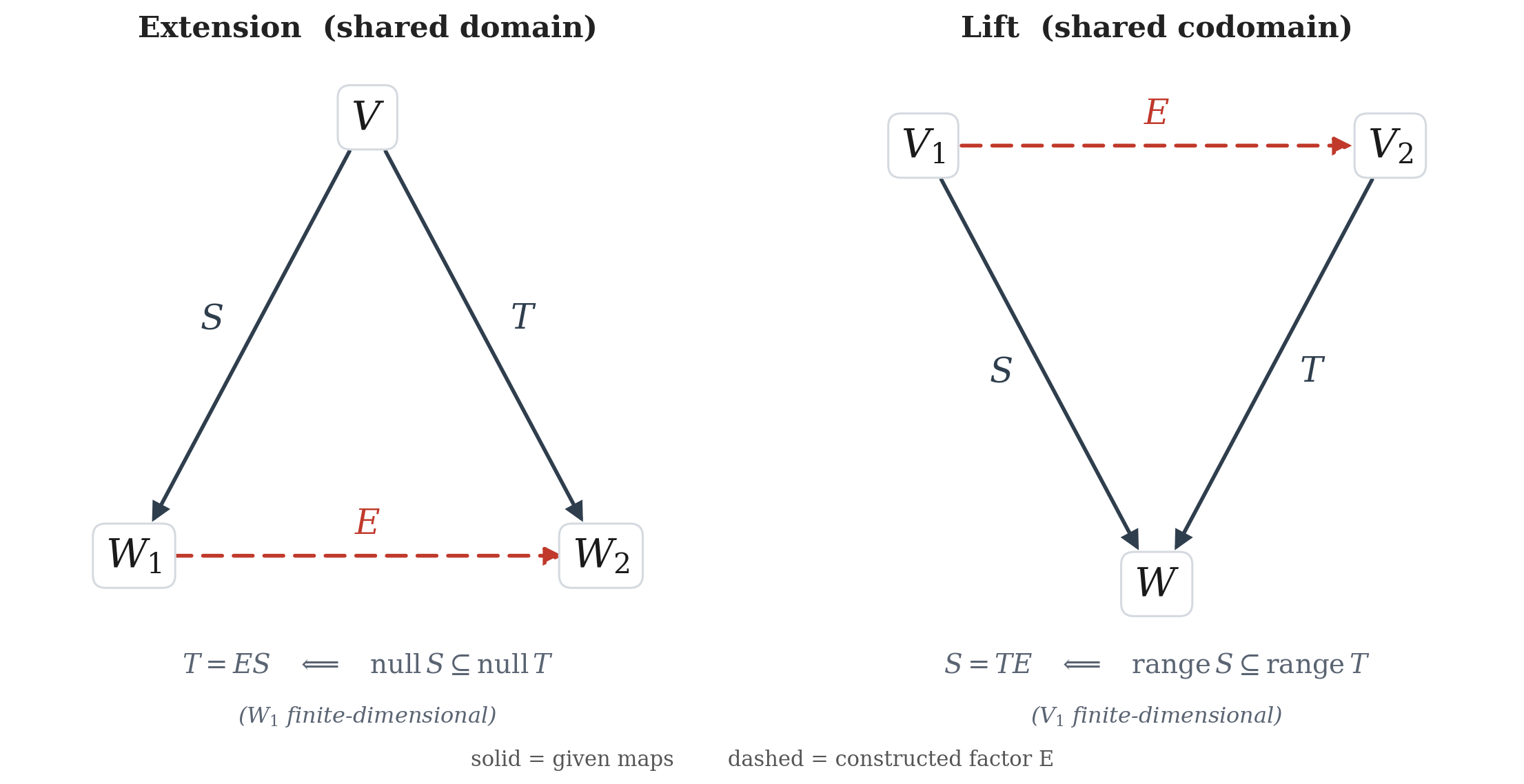
Suppose $ W_1 $ is finite-dimensional, $ S \in \mathcal{L}(V, W_1) $ and $ T \in \mathcal{L}(V, W_2) $. Then \(\operatorname{null} S \subseteq \operatorname{null} T \iff \exists\, E \in \mathcal{L}(W_1, W_2) \ \text{s.t.}\ T = ES.\)
($\Leftarrow$) If $T = ES$ and $Sv = 0$, then $Tv = E(Sv) = E0 = 0$, so $\operatorname{null} S \subseteq \operatorname{null} T$.
($\Rightarrow$) We build $E : W_1 \to W_2$ with $E(Sv) = Tv$ for all $v$.
For $w \in \operatorname{range} S$, write $w = Sv$ and set $Ew := Tv$. This is well-defined: if $Sv_1 = Sv_2$, then $v_1 - v_2 \in \operatorname{null} S \subseteq \operatorname{null} T$, so $Tv_1 = Tv_2$. It is linear on $\operatorname{range} S$ since, writing $w_i = Sv_i$, \(E(aw_1 + bw_2) = E\bigl(S(av_1+bv_2)\bigr) = T(av_1+bv_2) = aEw_1 + bEw_2.\)
Because $W_1$ is finite-dimensional, $\operatorname{range} S$ has a complement: \(W_1 = \operatorname{range} S \oplus U.\) Define $E$ to be $0$ on $U$ and extend linearly to all of $W_1$. Then $Ew \in W_2$ for every $w$, and $ES = T$. $\blacksquare$
Lift (shared codomain)
Suppose $ V_1 $ is finite-dimensional, $ S \in \mathcal{L}(V_1, W) $ and $ T \in \mathcal{L}(V_2, W) $. Then \(\operatorname{range} S \subseteq \operatorname{range} T \iff \exists\, E \in \mathcal{L}(V_1, V_2) \ \text{s.t.}\ S = TE.\)
($\Leftarrow$) If $S = TE$, then $Sv = T(Ev) \in \operatorname{range} T$ for all $v$, so $\operatorname{range} S \subseteq \operatorname{range} T$.
($\Rightarrow$) Because $V_1$ is finite-dimensional, pick a basis $v_1, \dots, v_n$ of $V_1$. For each $j$, the vector $Sv_j$ lies in $\operatorname{range} S \subseteq \operatorname{range} T$, so there exists $u_j \in V_2$ with \(T u_j = S v_j.\) (The preimage $u_j$ lives in $V_2$ because $T$ starts at $V_2$ — which is exactly why $E$ ends up in $\mathcal{L}(V_1, V_2)$.) Define $E \in \mathcal{L}(V_1, V_2)$ to be the unique linear map with $E v_j = u_j$ for every $j$. Then for each basis vector, \((TE)(v_j) = T(E v_j) = T(u_j) = S v_j.\) So $TE$ and $S$ agree on a basis of $V_1$, hence $TE = S$. $\blacksquare$
Removing the finite-dimensional hypotheses
Both laws hold in every dimension under the Axiom of Choice; the finite-dimensional hypotheses are conveniences, not necessities.
- Extension used $W_1$ finite-dimensional only to give $\operatorname{range} S$ a complement in $W_1$. Under AC, every subspace of every vector space has a complement, so the hypothesis can be dropped.
- Lift used $V_1$ finite-dimensional only to supply a basis of $V_1$ and to choose a preimage $u_j$ for each basis vector. Under AC, every vector space has a (Hamel) basis and the preimages can be chosen simultaneously, so the hypothesis can be dropped.
The reverse ($\Leftarrow$) directions use neither a complement nor a basis, so they are choice-free in all dimensions. Structurally, the two facts being invoked are that in $\mathbf{Vect}$ every object is both injective (extension along monos) and projective (lifting along epis).
Extension and Lift are Transposes
The two laws are one statement seen through the dual map $M \mapsto M’$. Transpose the Extension data — $S : V \to W_1$ and $T : V \to W_2$, sharing the domain $V$ — to get $S’ : W_1’ \to V’$ and $T’ : W_2’ \to V’$, now sharing the codomain $V’$, which is a Lift configuration. The conclusion transposes with it, $T = ES \mapsto T’ = S’E’$, turning “$T$ factors through $S$ on the left” into “$T’$ factors through $S’$ on the right.”
And the hypotheses correspond: since $\operatorname{range} M’ = (\operatorname{null} M)^0$, and since $U \mapsto U^0$ is an inclusion-reversing bijection on subspaces (its inverse is $U^0 \mapsto U^{00} = U$, the double-annihilator identity), \(\operatorname{null} S \subseteq \operatorname{null} T \iff (\operatorname{null} T)^0 \subseteq (\operatorname{null} S)^0 \iff \operatorname{range} T' \subseteq \operatorname{range} S'.\) So the Extension problem for $(S, T)$ is exactly the Lift problem for its transposes $(T’, S’)$.
Freedom in $E$
Both constructions made an arbitrary choice: the extension off a complement, or the preimages of a basis. In each case the set of all valid factors is a translate: fix one solution $E_0$, and every other differs from it by a solution of the homogeneous equation. Measuring that homogeneous space measures the freedom.
Extension: forced on $\operatorname{range} S$, free on a complement.
The defining equation $ T = ES $ constrains $E$ only through the vectors $Sv$, i.e. only on $\operatorname{range} S$, where it is forced to be $E(Sv) = Tv$. On a complement $U$ in $W_1 = \operatorname{range} S \oplus U$ the equation says nothing, so $ \left. E \right\rvert_U$ can be any linear map $U \to W_2$. The proof took $0$, but that was one choice among many. Concretely, if $E_1 S = E_2 S = T$ and $ F = (E_1 - E_2) $, then $ FS = 0 $, i.e. $ F $ vanishes on $\operatorname{range} S$; such $ F $ factor through the quotient, so the freedom is exactly
\[\{ F : FS = 0 \} \cong \mathcal{L}(W_1 / \operatorname{range} S, W_2),\] \[\dim = \big(\dim W_1 - \dim \operatorname{range} S\big)\cdot \dim W_2.\]The factor $E$ is unique $ \iff $ $ S $ is surjective ($ \operatorname{range} S = W_1 $): only then is there no complement to be free on. The freedom lives on the source of $E$, precisely where $S$ fails to fill $W_1$.
Lift: determined modulo $\operatorname{null} T$.
Here $TE = S$ fixes each value $Ev_j$ only up to a preimage of $Sv_j$, and any two preimages differ by an element of $\operatorname{null} T$. So the choice of preimages is the freedom. Concretely, if $TE_1 = TE_2 = S$ and $G = E_1 - E_2$, then $ TG = 0 $, i.e. $\operatorname{range} G \subseteq \operatorname{null} T$; the freedom is exactly
\[\{ G : TG = 0 \} \cong \mathcal{L}(V_1, \operatorname{null} T),\] \[\dim = \dim V_1 \cdot \dim \operatorname{null} T.\]The factor $E$ is unique $ \iff$ $T$ is injective ($\operatorname{null} T = {0}$): only then is there a single preimage to choose. The freedom lives on the target of $E$, precisely where $T$ collapses.
Left and Right Inverse
Setting one given map to an identity collapses each law into a one-sided inverse:
Extension. Put $T = I_V$. The hypothesis $\operatorname{null} S \subseteq \operatorname{null} I_V = {0}$ says $S$ is injective, and $I_V = ES$ makes $E$ a left inverse of $S$. A left inverse is called a retraction of $S$, and an injective map that admits one is a split monomorphism.
Lift. Put $S = I_W$. The hypothesis $W = \operatorname{range} I_W \subseteq \operatorname{range} T$ says $T$ is surjective, and $I_W = TE$ makes $E$ a right inverse of $T$. A right inverse is called a section of $T$, and a surjective map that admits one is a split epimorphism.
So,
injective $\iff$ has a retraction and surjective $\iff$ has a section.
A retraction is automatically surjective and a section automatically injective, so the two constructions say that in $\mathbf{Vect}$ every injective map splits (has a retraction) and every surjective map splits (has a section) — the linear-algebra form of “every mono and every epi splits.”
These two equivalences are transposes of each other, inherited from the Extension↔Lift duality above.
Since setting a map to the identity commutes with transposing, the retraction↔section pairing is that duality evaluated at $I$: a retraction $ST = I_V$ dualizes to $T’S’ = I_{V’}$, a section of $T’$. Bringing in the second annihilator identity $\operatorname{null} M’ = (\operatorname{range} M)^0$ alongside the first completes the dictionary between the two maps’ properties:
\[T \text{ injective} \iff T' \text{ surjective}, \qquad T \text{ surjective} \iff T' \text{ injective}.\]So the transpose swaps injective with surjective in the very stroke that swaps retraction with section: “$T$ is injective, hence has a retraction” read on the dual side is exactly “$T’$ is surjective, hence has a section.” The left/right asymmetry is one phenomenon, seen through $M \mapsto M’$.
Equal Range, Equal Null Space
Strengthening either inclusion to an equality upgrades the factor $E$ from a one-directional map into an isomorphism. Where setting a map to the identity made $E$ a one-sided inverse of one map, equality makes $E$ a two-sided invertible map that relates the two maps. The equality is just the inclusion holding in both directions, and those two directions are the two sides of $E$’s invertibility.
Equal null space — differ by a codomain automorphism
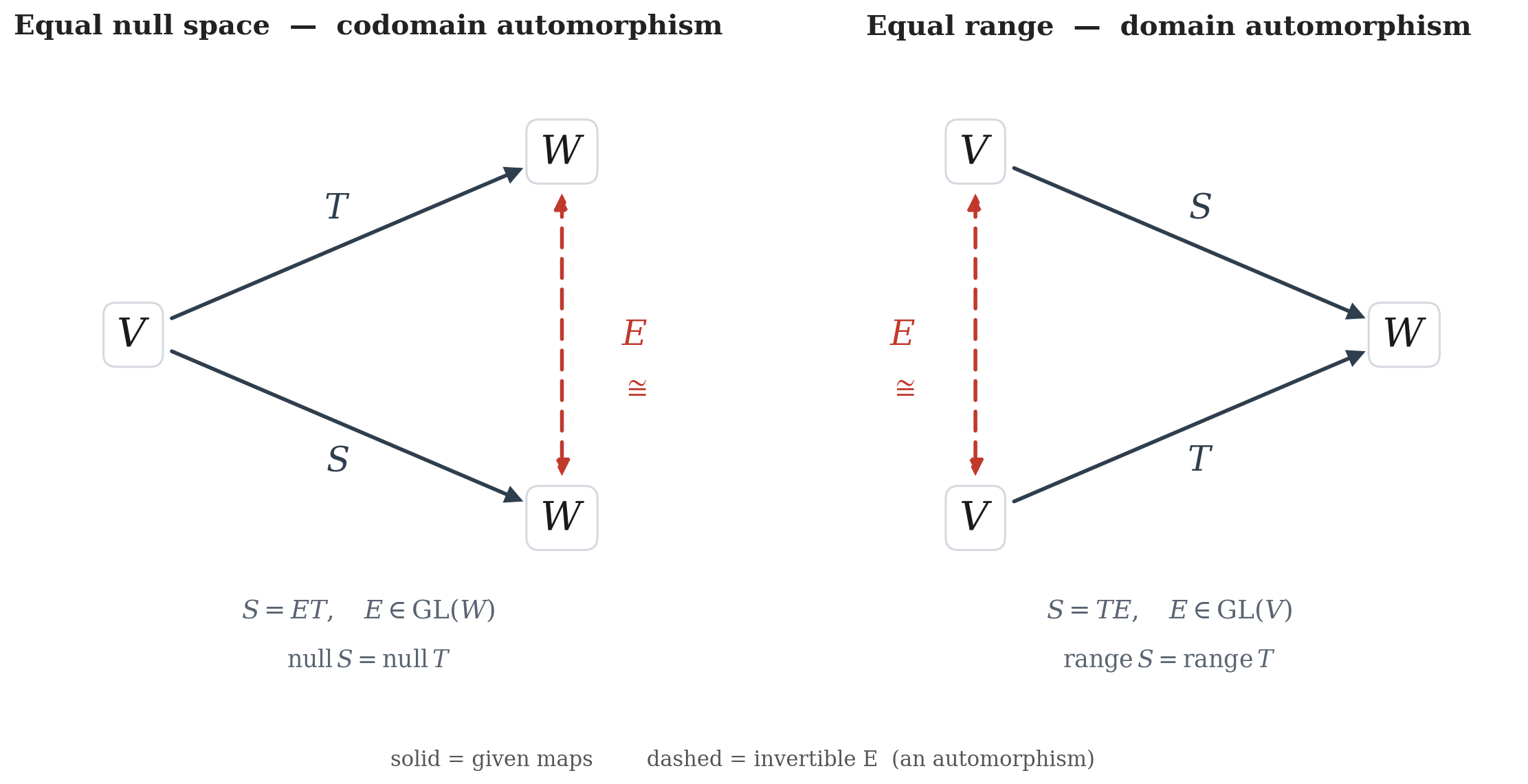
Suppose $W$ is finite-dimensional and $S, T \in \mathcal{L}(V, W)$. Then \(\operatorname{null} S = \operatorname{null} T \iff \exists\, \text{invertible } E \in \mathcal{L}(W) \ \text{s.t.}\ S = ET \ (\text{equivalently } T = E^{-1}S).\)
Equal range — differ by a domain automorphism
Suppose $V$ is finite-dimensional and $S, T \in \mathcal{L}(V, W)$. Then \(\operatorname{range} S = \operatorname{range} T \iff \exists\, \text{invertible } E \in \mathcal{L}(V) \ \text{s.t.}\ S = TE \ (\text{equivalently } T = SE^{-1}).\)
($\Leftarrow$) Both directions are immediate: if $S = TE$ with $E$ invertible then $\operatorname{range} S \subseteq \operatorname{range} T$ and $\operatorname{range} T = \operatorname{range}(SE^{-1}) \subseteq \operatorname{range} S$; the null space case is dual.
($\Rightarrow$, equal null space) Let $N = \operatorname{null} S = \operatorname{null} T$. Define $E$ on $\operatorname{range} T$ by $E(Tv) := Sv$. This is well-defined and injective: $Tv = Tv’ \iff v - v’ \in N \iff Sv = Sv’$. So $E : \operatorname{range} T \to \operatorname{range} S$ is an isomorphism. By rank–nullity the two ranges have equal dimension, hence so do their complements $W = \operatorname{range} T \oplus U_T = \operatorname{range} S \oplus U_S$; extend $E$ by any isomorphism $U_T \to U_S$. Then $E \in \mathcal{L}(W)$ is invertible and $ET = S$.
($\Rightarrow$, equal range) Dual: decompose $V = \operatorname{null} S \oplus C_S = \operatorname{null} T \oplus C_T$, send $C_S \to C_T$ by $(\left. T \right\rvert_{C_T})^{-1}(\left. S \right\rvert_{C_S})$ and $\operatorname{null} S \to \operatorname{null} T$ by any isomorphism (equal dimension by rank–nullity). The resulting $E \in \mathcal{L}(V)$ is invertible with $TE = S$. $\blacksquare$
The reading is clean: same range means $S$ and $T$ agree up to a change of coordinates on the source, and same null space means they agree up to a change of coordinates on the target. In group-action language, two maps share a range exactly when they lie in one orbit of $\mathrm{GL}(V)$ acting by precomposition, and share a null space exactly when they lie in one orbit of $\mathrm{GL}(W)$ acting by postcomposition.
These two rows are genuinely finite-dimensional.
Unlike the inclusion laws — which survive to any dimension under the Axiom of Choice — the equality rows do not. Both proofs use rank–nullity to turn equal range into equal nullity (and vice versa), and that step fails in infinite dimensions: equal range no longer forces equal null space. For a counterexample, take $S = I$ and $T$ the left shift on the space of finitely-supported sequences. Both are surjective, so $\operatorname{range} S = \operatorname{range} T$, yet $\operatorname{null} S = {0} \neq \operatorname{null} T$. No invertible $E$ can satisfy $S = TE$, since that would force $T$ injective.