Dual Space
Notation
| Symbol | Meaning |
|---|---|
| $V$ | a vector space over $\mathbf{F}$ (nonzero, finite-dimensional unless stated) |
| $\mathcal{L}(V,W)$ | linear maps $V \to W$ |
| $V’$ | dual space of $V$ |
| $T’$ | dual (transpose) operator of $T$ |
| $V’’$ | double dual space, $(V’)’$ |
| $\Lambda$ | canonical map $V \to V’, (\Lambda v)(\varphi) = \varphi(v)$ |
| $U^0$ | annihilator of $U$: ${\varphi \in V’ : \varphi(u) = 0\ \forall u \in U}$ |
Dual Space and Dual Map
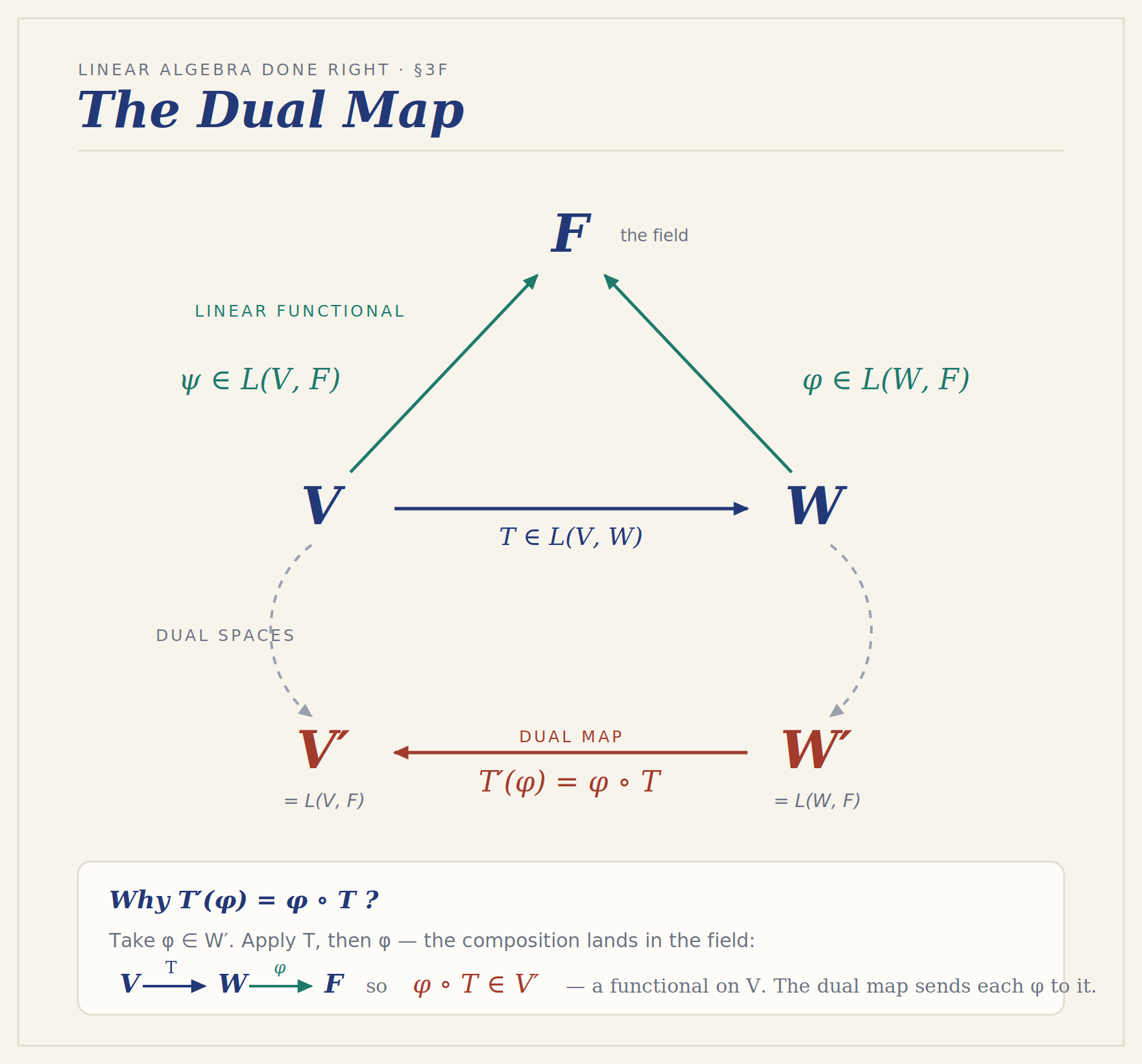
Suppose $V$ is finite-dimensional. Then $ V \cong V’ $, but finding an isomorphism from $V$ onto $V’$ generally requires choosing a basis of $V$.
$ \dim U^0 = \dim V - \dim U $
- $ \operatorname{null} T’ = (\operatorname{range} T)^0 $
$ \operatorname{range} T’ = (\operatorname{null} T)^0 $
- $ \dim \operatorname{null} T’ = \dim \operatorname{null} T + \dim W - \dim V $
- $ \dim \operatorname{range} T’ = \dim \operatorname{range} T $
Double Dual Space
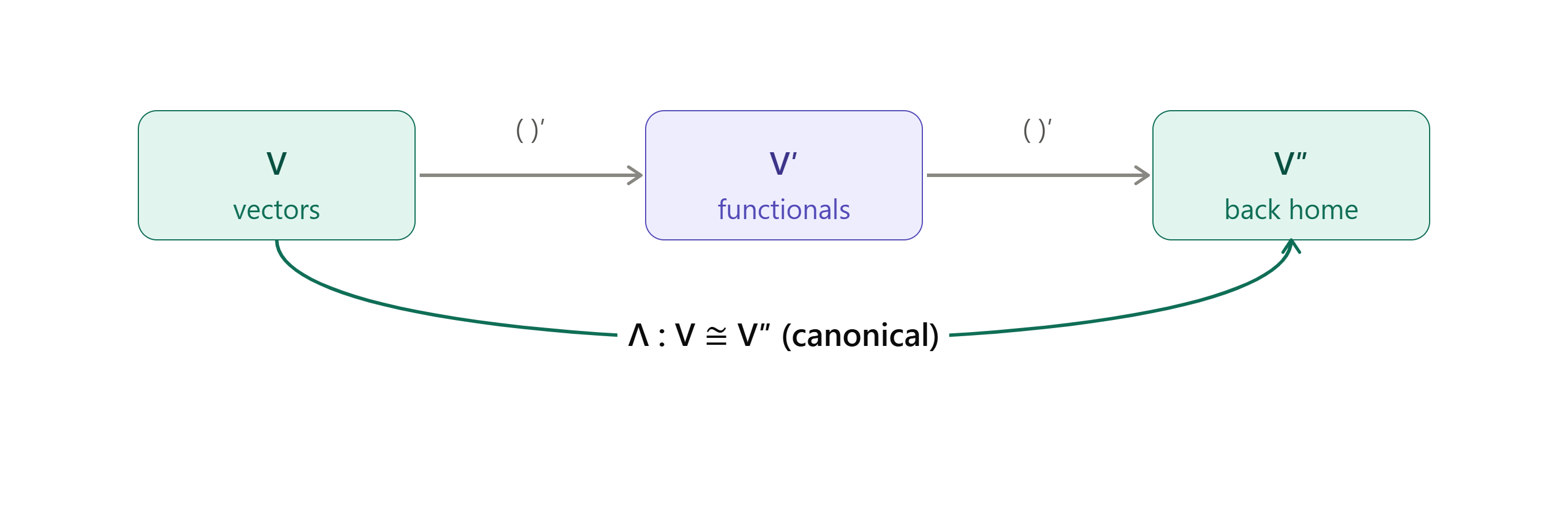
The double dual space of $V$, denoted by $V’’$, is defined to be the dual space of $V’$, i.e., $ V’’ = (V’)’ $.
Define $ \Lambda : V \to V’’ $ by
\[(\Lambda v)(\varphi) = \varphi (v)\]for each $ v \in V $ and each $ \varphi \in V’ $.
If $ T \in \mathcal(V) $, then $ T’’ \circ \Lambda = \Lambda \circ T $, where $ T’’ = (T’)’ $.
Both sides are maps $V \to V’’$, so fix $v \in V$ and show the two functionals $T’’(\Lambda v)$ and $\Lambda(Tv)$ agree — i.e. give the same scalar on every $\varphi \in V’$.
\[\big(T''(\Lambda v)\big)(\varphi) = \big((\Lambda v)\circ T'\big)(\varphi) = (\Lambda v)(T'\varphi) = (T'\varphi)(v) = (\varphi\circ T)(v) = \varphi(Tv).\]And the other side, straight from the definition of $\Lambda$:
\[\big(\Lambda(Tv)\big)(\varphi) = \varphi(Tv).\]They match for all $\varphi$, so $T’’(\Lambda v) = \Lambda(Tv)$ for all $v$, i.e. $T’’ \circ \Lambda = \Lambda \circ T$. $\blacksquare$
If $V$ is finite-dimensional, then $ V \cong_{\Lambda} V’’ $. This isomorphism does not require a choice of basis and thus is considered more natural (canonical).
Suppose $\Lambda v = 0$, meaning $\varphi(v) = 0$ for every $\varphi \in V’$. So $v = 0$, and $\operatorname{null}\Lambda = {0}$: $\Lambda$ is injective.
In finite dimensions $\dim V’ = \dim V$, and applying this twice gives
\[\dim V'' = \dim V' = \dim V.\]So $\Lambda$ is bijective, hence an isomorphism $V \xrightarrow{\sim} V’’$. $\blacksquare$
Bases
Suppose $ v_1, \dots, v_n $ is a basis of $V$ and $ \varphi_1, \dots, \varphi_n $ is the corresponding dual basis of $V’$.
- vector: $ v = \varphi_1(v)\,v_1 + \dots + \varphi_n(v)\,v_n \in V $
- covector: $ \psi = \psi(v_1)\,\varphi_1 + \dots + \psi(v_n)\,\varphi_n \in V’ $
The two bases are coordinate-readers for each other.
There’s a single expansion fact. For any space $W$ with basis $b_1,\dots,b_n$ and dual basis $\beta_1,\dots,\beta_n \in W’$:
\[w = \sum_i \beta_i(w)\,b_i \qquad \text{for all } w\in W.\]Coordinate = evaluate the dual basis vector.
Apply it to $W = V$. Basis $v_i$, dual basis $\varphi_i \in V’$.
\[v = \sum_i \varphi_i(v)\,v_i.\]Apply it to $W = V’$. Now the basis is $\varphi_1,\dots,\varphi_n$, and its dual basis does not live in $V$ — it lives in $(V’)’ = V’’$. Call it $\varphi_1’’,\dots,\varphi_n’’ \in V’’$, defined by $\varphi_i’’(\varphi_j) = \delta_{ij}$. The template spits out
\[\psi = \sum_i \varphi_i''(\psi)\,\varphi_i.\]By the double-dual identification $V\cong V’’$
\[\varphi_i''(\psi) = (\Lambda v_i)(\psi) = \psi(v_i).\]Therefore
\[\psi = \sum_i \psi(v_i)\,\varphi_i.\]
Annihilator
Annihilator
For $ U \subseteq V $,
\[U^0 = \{\varphi \in V' : \varphi(u) = 0 \ \forall u \in U \}.\]
Pre-annihilator
Suppose $V$ is finite-dimensional and $U$ is a subspace of $V$,
\[U = \{v \in V : \varphi(v) = 0 \ \forall \varphi \in U^0 \}.\]
Denote the collection of all subspaces of $V$ by $\mathrm{Sub}(V)$.
$(\mathrm{Sub}(V), \subseteq)$ is a lattice, with $(\wedge, \vee) = (\cap, +)$.
The annihilator map $ U \mapsto U^0 $ is an order-reversing bijection between $ \mathrm{Sub}(V) $ and $ \mathrm{Sub}(V’) $.
Suppose $ V $ is finite-dimensional and $ U $ and $ W $ are subspaces of $ V $.
- Double annihilator: $ (U^0)^0 = U $
- Antitone: $ W^0 \subseteq U^0 \Leftrightarrow U \subseteq W $
$W^0 \subseteq U^0 \implies U \subseteq W$
Prove the contrapositive: if $U \not\subseteq W$, then $W^0 \not\subseteq U^0$.
Suppose $U \not\subseteq W$, so there exists $u \in U$ with $u \notin W$. The goal is to produce a functional that lives in $W^0$ but not $U^0$ — one that kills all of $W$ yet doesn’t kill $u$.
Let $w_1, \dots, w_k$ be a basis of $W$. Since $u \notin W = \operatorname{span}(w_1,\dots,w_k)$, the list
\[w_1, \dots, w_k,\, u\]is linearly independent. Using finite-dimensionality, extend it to a basis $w_1, \dots, w_k,\, u,\, v_1, \dots, v_j$ of $V$. Now define $\varphi \in V’$ on this basis by
\[\varphi(w_i) = 0 \ (\text{all } i), \qquad \varphi(u) = 1, \qquad \varphi(v_\ell) = 0 \ (\text{all } \ell),\]extended linearly. Since $\varphi$ vanishes on a basis of $W$, it vanishes on all of $W$, so $\varphi \in W^0$. But $u \in U$ and $\varphi(u) = 1 \neq 0$, so $\varphi \notin U^0$. Therefore $W^0 \not\subseteq U^0$, completing the contrapositive. $\blacksquare$
Lattice anti-homomorphism:
- $ (U + W)^0 = U^0 \cap W^0 $
- $ (U \cap W)^0 = U^0 + W^0 $
By the double-annihilator fact $(A^0)^0 = A$ (under $V \cong V’’$). Apply (a) inside $V’$ to the subspaces $U^0, W^0$:
\[(U^0 + W^0)^0 = (U^0)^0 \cap (W^0)^0 = U \cap W.\]Now annihilate both sides and use $(A^0)^0 = A$ once more on the left:
\(U^0 + W^0 = \big((U^0 + W^0)^0\big)^0 = (U \cap W)^0.\) $\blacksquare$
Suppose $ V $ is finite-dimensional and $ \varphi_1, \dots, \varphi_m \in V’ $. Let $ N = \operatorname{null}\varphi_1 \cap \dots \cap \operatorname{null}\varphi_m \subseteq V$, $U = \operatorname{span}(\varphi_1,\dots,\varphi_m) \subseteq V’$. Then $ U = N^0$.
$N$ is the pre-annihilator of $U$ — the annihilator of $U$ taken back in $V$ under $V \cong V’’$:
\[v \in N \iff \varphi_i(v) = 0 \ \forall i \iff \varphi(v) = 0 \ \forall \varphi \in U \iff v \in U^0,\]So $N = U^0$ and $N^0 = U$. $\blacksquare$
Duality Swaps Spanning and Independence
Given $v_1,\dots,v_m \in V$, define
\[S: \mathbf{F}^m \to V, \qquad S(a_1,\dots,a_m) = a_1 v_1 + \dots + a_m v_m \quad (\text{so } e_i \mapsto v_i).\]Under this re-encoding:
- $ S \text{ surjective} \iff (v_i) \text{ spans } V $
- $ S \text{ injective} \iff (v_i) \text{ linearly independent} $
Both equivalences hold in any dimension — no finiteness needed.
The dual map $S’: V’ \to (\mathbf{F}^m)’ \cong \mathbf{F}^m$ is given by $S’(\varphi) = \varphi \circ S$, so its $i$-th coordinate is $(\varphi \circ S)(e_i) = \varphi(S e_i) = \varphi(v_i)$. That is,
\[S'(\varphi) = \big(\varphi(v_1),\dots,\varphi(v_m)\big).\]Now suppose $V$ is finite-dimensional, so the dual-map theorem applies: $T$ injective $\iff T’$ surjective, and $T$ surjective $\iff T’$ injective.
| map property | reason | list statement |
|---|---|---|
| $S$ surjective | definition | $(v_i)$ spans $V$ |
| $S$ injective | definition | $(v_i)$ linearly independent |
| $S’$ injective | $\iff S$ surjective | $(v_i)$ spans $V$ |
| $S’$ surjective | $\iff S$ injective | $(v_i)$ linearly independent |
Only the last two rows use finite-dimensionality (through the dual-map theorem). The first two are dimension-free.
Dualizing: replace $V$ by $V’$
The identical construction, with the base space changed from $V$ to $V’$. The list $\varphi_1,\dots,\varphi_m$ now lives in $V’$, so its encoding map is
\[R: \mathbf{F}^m \to V', \quad e_i \mapsto \varphi_i.\]Its transpose is $R’: V’’ \to (\mathbf{F}^m)’ \cong \mathbf{F}^m$. Under the canonical isomorphism $V \cong V’’$, the element of $V’’$ corresponding to $v \in V$ is evaluation-at-$v$, written $\hat v$ with $\hat v(\varphi) = \varphi(v)$; feeding that to $R’$ gives
\[R'(\hat v) = (\varphi_1(v),\dots,\varphi_m(v)).\]| map property | reason | list statement |
|---|---|---|
| $R$ surjective | definition | $(\varphi_i)$ spans $V’$ |
| $R$ injective | definition | $(\varphi_i)$ linearly independent |
| $R’$ injective | $\iff R$ surjective | $(\varphi_i)$ spans $V’$ |
| $R’$ surjective | $\iff R$ injective | $(\varphi_i)$ linearly independent |
Back to the annihilator
The null space of $R’$ is the common null space of the functionals:
\[\operatorname{null} R' = \{v : \varphi_i(v) = 0 \ \forall i\} = \operatorname{null}\varphi_1 \cap \dots \cap \operatorname{null}\varphi_m.\]By the dual-map identity $\operatorname{null} T’ = (\operatorname{range} T)^0$ applied to $T = R$, and since $\operatorname{range} R = \operatorname{span}(\varphi_i)$,
\[\operatorname{null}(R') = (\operatorname{range} R)^0 = \big(\operatorname{span}(\varphi_i)\big)^0.\]Annihilating both sides yields
\[\operatorname{span}(\varphi_i) = \big(\operatorname{null}\varphi_1 \cap \dots \cap \operatorname{null}\varphi_m\big)^0.\]Suppose $V$ is finite-dimensional and $ \varphi_1, \dots, \varphi_n $ is a basis of $V’$. Then there exists a basis of $V$ whose dual basis is $ \varphi_1, \dots, \varphi_n $.
Define
\[\Gamma:V\to\mathbf{F}^n,\qquad \Gamma(v)=\big(\varphi_1(v),\dots,\varphi_n(v)\big).\]This is an isomorphism. Now set $v_k=\Gamma^{-1}(e_k)$, where $e_1,\dots,e_n$ is the standard basis of $\mathbf{F}^n$. These form a basis of $V$, and $\Gamma(v_k)=e_k$ unpacks to $\varphi_j(v_k)=\delta_{jk}$, as required. $\blacksquare$